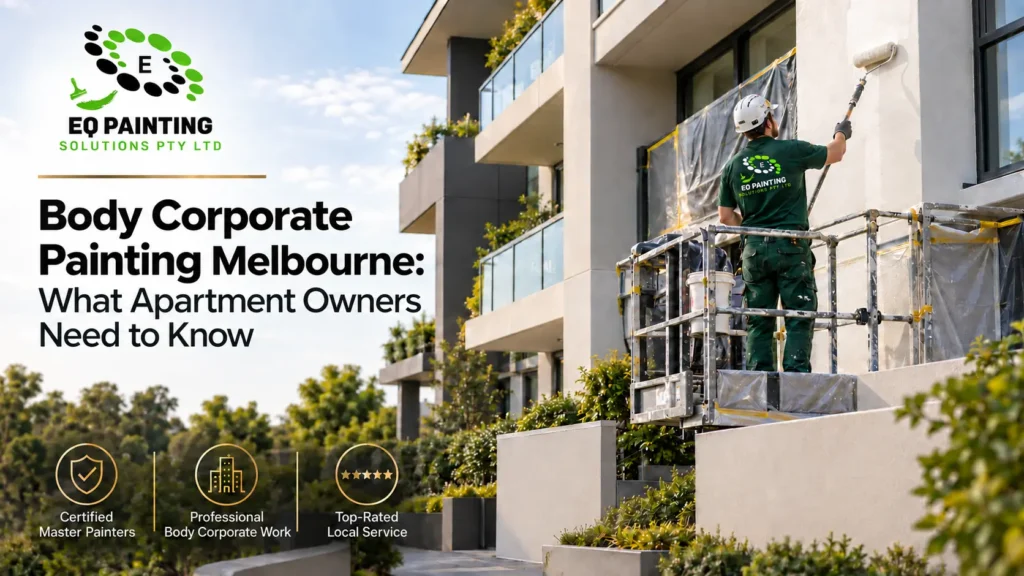
Painting a body corporate or strata property is a different job to painting a single house, and not because of the paint. The complexity is in the coordination: multiple owners, a committee, a strata manager, shared budgets, access to occupied units, and the need to keep the whole thing running while work is underway. A quick note on terms: in Victoria the official name for what many people call a “body corporate” is an owners corporation, and that’s the term the paperwork and your strata manager will use, so we use it through this guide. When an owners corporation in South Yarra, Port Melbourne or St Kilda starts planning an exterior repaint, the questions that actually matter are rarely about colour. This guide covers what apartment owners and committees need to know before commissioning the work in Melbourne.
Why Body Corporate Painting Is a Specialised Job
A standalone home has one decision-maker. An owners corporation property has a committee, a manager, and every owner with a stake in both the outcome and the cost. That changes how the work has to be planned from the very start:
- Shared decision-making. Colours, scope and timing usually need committee approval, and sometimes a vote at a general meeting, so the planning runs on a longer lead time than a private job.
- Occupied buildings. Residents are living there throughout, so access to balconies, walkways and common property has to be scheduled around people, not just weather.
- Budget accountability. The cost comes from owners’ funds, often the maintenance or sinking fund, so quotes need to be detailed and defensible, not a single lump-sum figure.
None of this is a reason to over-complicate the job, but it does mean the painter you engage needs to be comfortable working with a committee and a strata manager, not just turning up with a ladder.
How Body Corporate Painting Is Quoted
A proper owners corporation quote should be more detailed than a standard home quote, because more people need to understand exactly what they’re paying for. A good scope typically breaks down the common-property surfaces (external walls, common walkways, stairwells, railings, entry areas), the preparation involved, the number of coats, the products, and how access equipment will be handled for multi-storey buildings.
Vague quotes cause problems on strata jobs specifically, because a committee can’t approve spending owners’ money against a one-line figure. The more transparent the breakdown, the smoother the approval process and the fewer disputes later about what was and wasn’t included.
Planning Access Around Residents
The single biggest practical difference on this kind of job is that people are living in the building the whole time. That shapes the entire schedule:
- Balconies and private courtyards need coordinated access, often with notice to individual residents.
- Common walkways and stairwells have to stay usable, so work is often staged section by section rather than closing everything at once.
- Scaffolding or elevated work platforms on multi-storey buildings need to be planned around entrances, parking and pedestrian safety.
Clear communication with residents ahead of time, usually coordinated through the strata manager, prevents most of the friction that otherwise comes up mid-job.
Insurance and Safety on Occupied Buildings
Before work begins, the committee should confirm that the contractor holds current public liability insurance and has appropriate safety procedures for scaffolding, elevated work platforms, balconies, shared walkways and occupied buildings. The strata manager may also require certificates of currency and site-specific safety documentation before the job can start. On an occupied multi-storey building, this isn’t a formality, it’s what protects both the owners and the residents while the work is underway, so it’s worth confirming up front rather than assuming it’s in place.
Don’t Use Paint to Hide Bigger Problems
A repaint improves how a building looks, but it shouldn’t be used to cover up issues that need real repair. Structural cracks, water ingress, concrete spalling and failed waterproofing don’t go away under a coat of paint, they keep progressing underneath it, and the new finish fails early over the top. On older residential buildings especially, these issues should be assessed and repaired where necessary before painting, not painted over. A good contractor will flag anything they see rather than quietly coat over it.
What Committees Should Look For in a Painter
Beyond the usual signs of a competent painter, an owners corporation committee should specifically look for experience with strata and commercial work, current public liability insurance and any documentation required by the owners corporation or strata manager, a willingness to provide a detailed written scope, and a clear plan for managing access and resident communication. A painter who has only ever done single homes may do good work but still struggle with the coordination a strata job demands.
It’s also worth asking how they handle variations, since discovering additional repair work mid-job is common on older buildings, and the committee will want to know how that gets approved and costed before it happens rather than after.
Related Articles
If you’re planning painting for a multi-owner or commercial property, these guides go deeper:
Frequently Asked Questions
A well-run body corporate paint job comes down to a painter who can handle the coordination as capably as the painting: detailed scope, staged access, and clear communication with the committee and residents throughout.
Planning painting for a strata or apartment property? Get in touch with EQ Painting Solutions for a detailed quote — call 0498 200 654 or request a quote online.
Pingback: Cost to Paint an Apartment Building in Melbourne (2026)