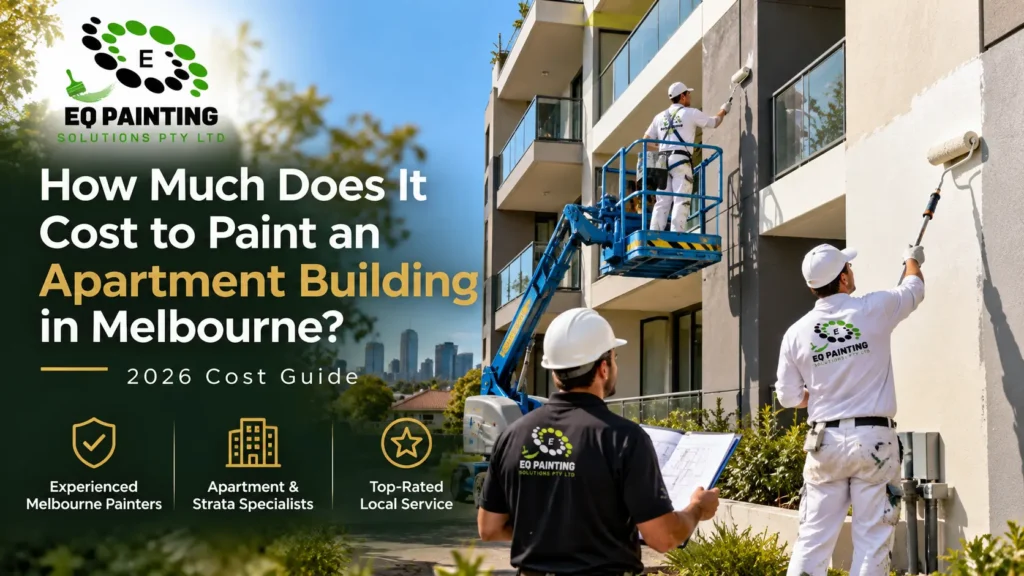
When an owners corporation starts planning a repaint, the first real question is rarely about colour — it’s what the job will cost the owners. For a whole apartment building, the honest answer is a wide range: a small block’s common areas often start around $8,000, while a larger complex’s exterior program can run into six figures. The cost to paint an apartment building in Melbourne depends far more on access, building height and how much is shared common property than on the paint itself.
After 15 years painting residential and strata buildings across Melbourne, we regularly see quotes that differ enormously for what sounds like the same building — usually because each painter has scoped access, preparation and common areas differently. This guide breaks down the real cost drivers, realistic budgeting ranges, and how an owners corporation can plan with confidence. For the coordination and approval side of the work, our guide to body corporate painting in Melbourne covers the process; here we focus on the numbers.
What Does It Cost to Paint an Apartment Building in Melbourne?
As a rough guide, a small block’s common areas often fall between $8,000 and $25,000, while larger and multi-storey programs can exceed $70,000 and run into six figures. In line with our commercial painting rates, interior common areas are typically $20–$45 per square metre and exterior facades $25–$70 per square metre — but access and height move these figures a lot, so treat them as budgeting starting points, not fixed prices.
| Scope | Indicative Melbourne budget |
|---|---|
| Small block (common areas) | $8,000–$25,000 |
| Larger / multi-storey program | Can exceed $70,000, into six figures |
| Interior common areas | $20–$45/m² |
| Building facade (exterior walls) | $25–$70/m² |
| Balustrades & metalwork | Site-specific (priced per lineal metre) |
These are indicative Melbourne budgeting ranges, not fixed prices. The final figure depends on access, building height, surface condition, preparation, number of coats and the coating system — which is exactly what the next section unpacks.
What Actually Drives the Price
Two apartment buildings of the same size can be tens of thousands of dollars apart. On a block, the biggest cost drivers are rarely the paint:
- Access and height: often the single largest cost variable. Scaffolding, elevated work platforms or specialist rope access can add substantially to the total — on a multi-storey facade, access alone can add around 15–25% — so a three-storey walk-up is a very different job to a mid-rise facade.
- How much is common property: exterior walls, corridors, lobbies, stairwells, car parks, balustrades and shared areas all add up. The more shared surface in scope, the larger the job.
- Surface condition and prep: render cracks, concrete spalling and failed coatings on older blocks in Fitzroy, Richmond or St Kilda add prep hours you won’t see quoted separately unless you ask.
- Occupied building and staging: residents live there throughout, so work is staged section by section and scheduled around access — that adds time, and time is labour.
- Coating system: a weather-exposed facade needs a proper exterior or render coating, which costs more per litre and per hour than a standard interior acrylic.
Want a number your committee can actually approve rather than argue over? Our commercial and strata painters in Melbourne measure on site before pricing, so the scope is clear before anyone signs.
Common Property vs Your Own Apartment: Who Pays for What?
What counts as common property depends on the registered plan of subdivision. Corridors, foyers, stairwells, exterior walls and shared areas are often common property — but the boundaries vary between developments, so it isn’t automatic. Common property is maintained by the owners corporation and funded from its maintenance fund (sometimes informally called a sinking fund), while the inside of your own lot is your own cost. Before budgeting any painting work, check the plan of subdivision and confirm responsibility with the owners corporation or manager, because the moment a job touches common property, the committee has a say.
If you’re only repainting the inside of your own unit, that’s closer to a standard interior job — our guide on the cost to paint a house in Melbourne gives realistic per-room and per-metre figures for a single dwelling.
How Apartment Painting Is Priced: Per Metre, Per Level or Per Unit
Strata quotes are usually built from a mix of measures rather than one flat rate. Facades and large exterior walls are priced per square metre. Corridors and stairwells are often priced per level, since each floor is a repeatable unit of work. Townhouse-style blocks are sometimes quoted on a per-unit program rate. A good quote will show you which measure applies to which part of the building, not just a single bottom-line number — which also makes it far easier for a committee to compare one quote against another.
Height Access and Safety Requirements
External painting on an apartment building is work at height, and that carries real safety obligations. Multi-storey facades usually need scaffolding, elevated work platforms (EWPs) or rope access with proper fall-protection controls. Higher-risk work — for example, facade work with a risk of a fall of more than two metres — is classed as high-risk construction work in Victoria and typically requires a Safe Work Method Statement (SWMS) before it starts. Your contractor should also hold current public liability insurance, and your strata manager may ask for certificates of currency and site-specific safety documentation. On an occupied building, this isn’t just paperwork — it’s what protects residents and owners while the work is underway.
How Long Does an Apartment Block Repaint Take?
A small block’s common areas might take one to two weeks. A full exterior program on a mid-size building often runs several weeks once you account for access setup, staging around residents, and weather. Melbourne’s winter is the quiet enemy here: cold, damp conditions slow exterior drying and recoat times, so an autumn or spring window usually keeps a facade program on schedule.
How an Owners Corporation Can Keep Costs Down
You don’t cut an apartment painting bill by chasing the lowest quote — you cut it by scoping the job well. A few practical moves:
- Get two or three detailed written quotes, each broken down by scope (facade, corridors, balustrades), not a single lump sum.
- Identify and rectify underlying defects — active water ingress, significant cracking, concrete spalling — before the coating goes on. Some of these may need assessment or repair by an appropriately qualified contractor first; a coat over a failing surface fails early and gets paid for twice.
- Bundle common areas and the facade into one program rather than piecemeal jobs, so access equipment is set up once.
- Book the work into a good weather window to avoid winter drying delays.
- Plan repaints through the owners corporation’s maintenance fund so the cost is spread, not a sudden special levy.
For how these figures compare with offices, retail and warehouses, see our full breakdown of commercial painting costs in Melbourne.
Related Articles
If you’re budgeting a strata or apartment repaint, these guides go deeper:
Frequently Asked Questions
The Bottom Line for Owners and Committees
There’s no single price to paint an apartment building in Melbourne — there’s a scope, and the scope decides the number. Access and height, how much common property is involved, and the condition of the surfaces matter far more than the brand of paint. Get two or three detailed, scope-by-scope quotes, fix what needs fixing before painting, and budget through the maintenance fund rather than a sudden levy, and the cost becomes something a committee can plan for rather than dread.
EQ Painting Solutions paints and repaints apartment buildings, townhouse blocks and strata properties across Melbourne — from South Yarra and Port Melbourne to St Kilda — and we measure on site before we price, so your committee gets a number it can actually approve. Free quotes across Melbourne. Call 0498 200 654 or request your free quote today.