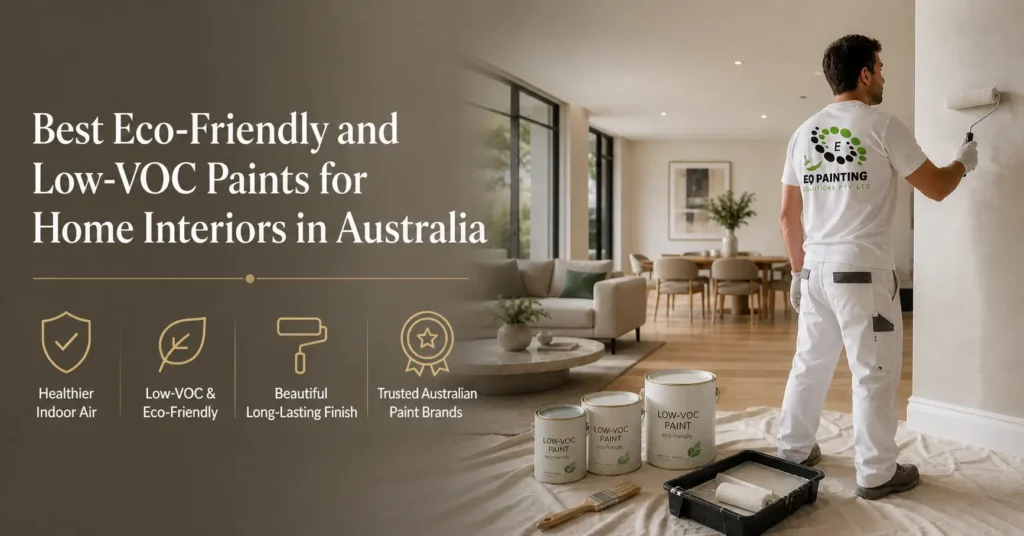
The air inside your home can carry more pollutants than the air outside — and fresh paint is a common culprit. Standard paints release volatile organic compounds (VOCs) as they dry, which is that strong “new paint” smell. A good low VOC paint — often searched for as non-toxic paint or non toxic paint — cuts those emissions right down, so your walls look great without filling the room with fumes.
Australia now has excellent eco-friendly options, from ultra-low-VOC mainstream brands to fully natural mineral paints. Whether you searched for eco friendly paints broadly or low VOC paint specifically, this guide compares the best eco-friendly and low-VOC paints for home interiors in Australia. You will see what sets each one apart and how to pick the right one for your space. For the health and sustainability case behind them, read our guide to the benefits of eco-friendly paint in an Australian home.
What Makes a Paint Eco-Friendly?
A few features separate a genuinely eco-friendly paint from clever marketing:
- Very low or zero VOCs — the biggest factor for clean indoor air.
- Natural or mineral bases — plant oils, earth pigments, lime or clay instead of synthetics.
- Water-based formulas — easier cleanup and lower environmental impact.
- Trusted certifications — GECA, APAS or Global GreenTag back up the claims.
- Mould and mildew resistance — important in Melbourne’s cooler, damper homes.
The Best Eco-Friendly and Low-VOC Interior Paints in Australia
Here are five of the strongest options on the Australian market, from fully natural to certified low-VOC.
Painted Earth
A fully natural Australian range: limewash, mineral paints and wood finishes with no synthetic nasties. It suits anyone chasing the most natural, breathable finish, or living with chemical sensitivities.
Wattyl I.D Advanced
Ultra-low VOC, under 1 g per litre — well below green building limits. It carries GECA and APAS accreditation and stays washable, stain-resistant and mould-resistant. A strong all-rounder for everyday interiors.
Haymes Ultra Premium
Several paints in this range hold Global GreenTag certification with very low VOCs. Haymes pairs sustainability with durability and mould resistance, so you do not trade performance for health.
BIO Paints and Graphenstone
Natural, mineral-based paints made from plant oils, earth pigments and lime. They skip synthetic chemicals and microplastics, let walls breathe, and suit the most eco-conscious homes.
Benjamin Moore Eco Spec
Water-based with low environmental impact, and available in flat, eggshell and semi-gloss. A reliable low-emission option for healthy indoor spaces.
ECOS Paints
An Australian-owned eco brand independently tested to some of the strictest low- and zero-VOC standards on the market. The range covers interior wall paint, primers and furniture-safe finishes, making it a solid one-stop option for anyone wanting a single trusted eco brand across a whole project.
| Brand | Type | VOC level | Certification | Best for |
|---|---|---|---|---|
| Painted Earth | Natural / mineral | Very low–zero | Natural range | Most natural finish, sensitivities |
| Wattyl I.D Advanced | Water-based | Under 1 g/L | GECA, APAS | Everyday all-rounder |
| Haymes Ultra Premium | Water-based | Very low | Global GreenTag | Premium durable finish |
| BIO Paints / Graphenstone | Natural / mineral | Very low–zero | Natural / mineral | Breathable, chemical-free |
| Benjamin Moore Eco Spec | Water-based | Low | Low-emission | Healthy standard finish |
| ECOS Paints | Water-based | Zero-VOC options | Independently tested | Whole-project eco brand, furniture-safe |
Don’t Forget the Primer: Low-VOC and VOC-Free Primers
People chase a low-VOC topcoat and then undo it with a standard primer, which is often the highest-VOC product in the whole job. If clean indoor air is the goal, pair your paint with a low-VOC or VOC-free primer. Most major brands now make one — Dulux enviro-labelled primers, the Wattyl I.D low-VOC undercoat and several water-based acrylic primers sit at very low VOC levels, and true VOC-free paint and primer systems are available in the natural mineral ranges like Graphenstone. The rule of thumb: a low-VOC paint over a solvent-based primer isn’t a low-VOC job. For bare plaster, patched walls or stain-blocking, ask specifically for a water-based, low-VOC paint primer rather than the default solvent one.
How to Choose the Right Eco-Friendly Paint
Match the paint to the room and the people in it:
- Nurseries and bedrooms — choose the lowest VOC you can, like Wattyl I.D Advanced or a natural mineral paint.
- Chemical sensitivities — go fully natural with Painted Earth, BIO Paints or Graphenstone.
- High-traffic areas — pick a washable, durable eco paint like Haymes Ultra Premium.
- Every project — check the certification (GECA, APAS or Global GreenTag) rather than the word “eco” on the tin.
- Furniture and spray projects — a standard wall paint isn’t built for either. Look for a furniture-safe low-VOC enamel (ECOS Paints and Wattyl both make one) for cabinets and furniture, and a purpose-made low-VOC spray paint or spray-thinned water-based enamel for spray application.
Want a hand picking the right eco paint for your rooms? Book a free assessment with our Melbourne team and we will recommend the best low-VOC option for your home.
Do Low-VOC Paints Perform as Well as Regular Paint?
Short answer: the good ones do. Modern low-VOC paints like Wattyl I.D Advanced and Haymes Ultra Premium cover well, wash easily and last. Very natural mineral paints look beautiful and breathe, though some need a little more care on prep and coats. Two coats over a properly prepared surface still gives the best result — eco or not.
Which Eco Paints We Recommend in Melbourne
For most Melbourne homes, we reach for Wattyl I.D Advanced or Haymes Ultra Premium — see our full guide to the best paint brands in Australia for how these compare. They offer low VOCs, a tough finish and good mould resistance for our cooler, damper winters. For nurseries, or anyone chasing the most natural option, we steer you to Painted Earth, BIO Paints or Graphenstone. Older weatherboard and brick homes around Melbourne often battle damp, so mould resistance matters as much as the eco rating.
Related Articles
Keep reading before you pick up a brush:
Frequently Asked Questions
The Bottom Line
You no longer have to choose between a healthy home and a great finish. From Painted Earth’s natural mineral paints to Wattyl I.D Advanced and Haymes’ certified low-VOC ranges, Australia has an eco-friendly interior paint for every room and budget. For a broader look at sustainable painting choices beyond just VOC content, see our guide to eco-friendly paint for Australian homes.
Want a hand choosing — or someone to paint it properly? Call EQ Painting Solutions on 0498 200 654 or request a free quote. We will help you pick a low-VOC finish that is safe, sustainable and built to last.
Pingback: Oil-Based vs Water-Based Paint: Which Is Better?