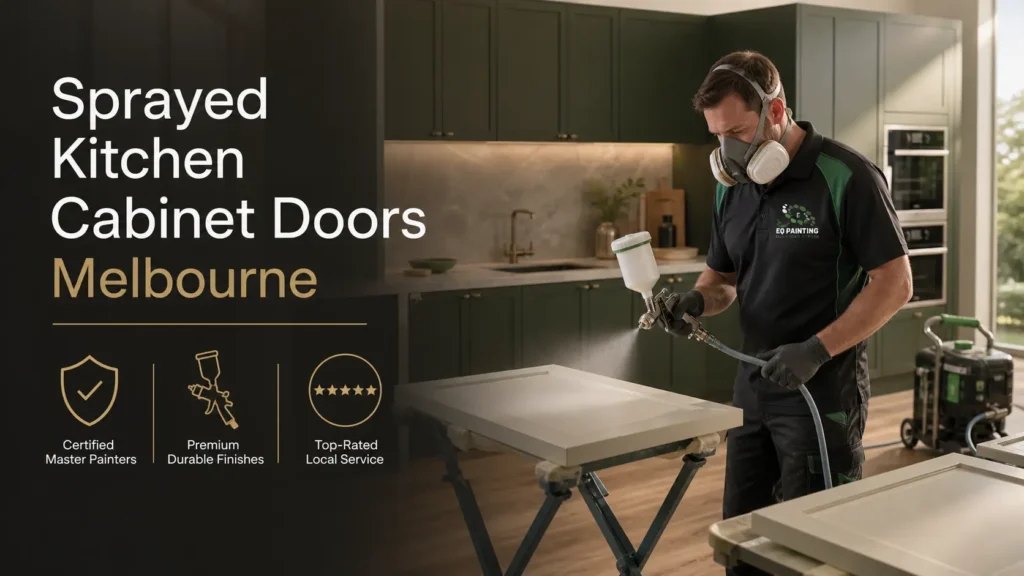
The kitchens we get called about in Hawthorn, Glen Iris and Mount Waverley usually follow the same pattern. The layout still works. The carcasses are solid. But the doors have gone that yellowed cream colour that dates a kitchen faster than anything else, and a replacement quote has just come back somewhere north of $25,000.
That’s the point where most homeowners start looking at spray painting kitchen cabinets instead — and it usually is the right call. A sprayed finish gives you the flat, even surface a brush and roller can’t match, on the cabinets you already own, for a fraction of a full renovation.
But it isn’t automatic. Some doors take a sprayed finish beautifully and hold it for a decade. Others start lifting inside two years, and no amount of good paint fixes that. The difference comes down to what your doors are actually made of, and how honestly the prep gets done.
Here’s what the job costs in Melbourne, how the process runs, when you get your kitchen back — and the situations where we’ll tell you to spend the money elsewhere.
What It Costs to Spray Kitchen Cabinets in Melbourne
Most Melbourne kitchens land between $2,500 and $7,000 for a full professional cabinet respray. The wide range isn’t vagueness — it tracks almost entirely with door count, door construction, and whether the work happens on site or off site.
| Scope | Typical Melbourne range |
|---|---|
| Bathroom vanity or small galley kitchen | $1,200 – $2,500 |
| Standard kitchen (15–25 doors and drawers) | $2,500 – $5,000 |
| Large kitchen with island and pantry | $5,000 – $7,000+ |
| Per door or drawer front | $100 – $250 |
Compare that to a full kitchen replacement, which in Melbourne comfortably runs $20,000 to $45,000 once you add joinery, plumbing, electrical and tiling. If the only thing wrong is how the kitchen looks, spraying is doing a much narrower job for much less money.
One thing worth knowing before you compare quotes: roughly three quarters of the cost is labour, not paint. Anyone quoting you well under these figures is almost certainly cutting prep, and prep is the entire job.
Why a Spray Gun Beats a Brush on Cabinet Doors
Sprayed cabinet doors look different because there is no applicator texture in the film. A brush leaves fine lines, a roller leaves stipple, and on a flat gloss or satin door in kitchen light, both read as “painted” from across the room. A sprayed coat lays down as one continuous film, which is why it passes for factory joinery.
The finish is also harder wearing. Cabinet doors get opened with wet hands, knocked with pans, and wiped with degreaser weekly. Two-pack polyurethane cures to a genuinely tough surface that handles that. Water-based enamels like Dulux Aquanamel have improved a lot and suit occupied homes better because of the lower odour, but a properly cured two-pack still wins on hardness.
Where a brush still earns its place is detailed shaker profiles and internal corners — which is why most quality jobs use both, spraying the faces and cutting in by hand where the gun can’t reach cleanly.
When We’ll Tell You Not to Spray Them
This is the part most cabinet painting guides skip, so here it is plainly. Spraying is the wrong answer in three situations.
- Vinyl-wrapped doors that are already peeling. The wrap is lifting off the MDF underneath. Paint bonds to the wrap, not the board, so you’re coating something already letting go. Once the wrap has started, the doors need replacing — the carcasses can still be sprayed.
- Swollen MDF near water. Look at the bottom edge of the door beside the dishwasher and under the sink. If the board has puffed up and gone soft, the damage is structural. Paint hides it for a season, then it telegraphs straight back through.
- Doors you already dislike. Spraying changes colour and finish. It doesn’t change a dated profile or a handle position that annoys you. If the shape of the door is the problem, new fronts on the existing carcasses are the smarter spend.
Solid timber, laminate in sound condition, painted MDF and melamine all take a sprayed finish well with the right primer. It’s the failing substrates that catch people out.
The Prep That Decides How Long It Lasts
Kitchen cabinets carry years of cooking oil, and that film is invisible until paint refuses to stick to it. Every door gets degreased with sugar soap and rinsed properly before anything else happens — skip this and the best primer on the market will still peel.
From there the sequence runs: hardware removed and labelled, doors sanded to key the existing surface, a bonding primer suited to the substrate (a shellac-based primer like Zinsser B-I-N for anything glossy or tannin-prone), then two sprayed topcoats with a light de-nib sand between them.
Melbourne’s winter works against you here. In July and August, humidity in an unheated kitchen pushes recoat times out noticeably beyond what the tin claims, and rushing the next coat onto a film that hasn’t flashed off properly is how you get a soft finish that marks under a fingernail. Good crews plan around that rather than pretending it isn’t happening.
If you’re weighing this against repainting the rest of the room, our Melbourne house painting cost guide puts the numbers side by side. And if you’d rather just have someone look at your actual kitchen, we’re happy to come out and quote it properly — including telling you if it isn’t worth doing.
On Site or Off Site: What Changes for a Kitchen You’re Living In
Doors and drawer fronts almost always come off and get sprayed in a controlled space, whether that’s a spray booth or a sealed-off area on site. Carcasses and frames stay put and get sprayed in place behind plastic zip walls with the room under negative pressure to keep overspray contained.
The practical difference for you is access. With the doors away being sprayed and cured, you keep working benches, taps and appliances the whole time — you just have open shelving for a week or so. Most families in occupied homes find that far easier than they expect.
Off-site spraying costs slightly more because of handling and transport, but it gives the cleanest result and the least dust in your house. On a kitchen you’re cooking in daily, that’s usually money well spent.
When You Can Actually Use the Kitchen Again
Touch dry and ready for use are two very different things. A sprayed cabinet finish is typically touch dry within hours and safe to rehang after a few days, but full cure — the point where the film has hardened enough to resist knocks, cleaning products and stacked crockery — takes considerably longer.
Plan on a working timeline of roughly five to ten days for a standard kitchen from strip-down to reassembly, then treat the finish gently for the first two to three weeks. That means no scrubbing, no sticky shelf liner, and closing doors rather than letting them swing shut. Most premature damage we see on cabinet jobs happens in that window, not years later.
Related Articles
If you’re planning work beyond the kitchen, these are worth a read:
Frequently Asked Questions
Most Melbourne kitchens fall between $2,500 and $7,000 for a full professional respray, or roughly $100 to $250 per door and drawer front. Small galley kitchens and vanities sit lower, around $1,200 to $2,500. Door count, door construction and whether the work is done on site or off site drive most of the variation.
For flat door faces, yes. A sprayed coat lays down as one continuous film with no brush lines or roller stipple, which is why it reads as factory joinery rather than a paint job. Brushes still earn their place on shaker profiles and internal corners, so most quality jobs use both.
Yes, provided the laminate is sound and not lifting. Laminate needs thorough degreasing, a proper sanding key and a bonding primer suited to a non-porous surface. What fails is vinyl wrap that has already started peeling away from the MDF underneath.
Plan on five to ten days for a standard kitchen from strip-down to reassembly. Larger kitchens with islands and pantries run longer, and Melbourne winter humidity stretches recoat times beyond what the tin states, so a July job typically takes longer than the same kitchen in February.
Almost always. Doors and drawer fronts are removed, labelled and sprayed in a controlled space, while carcasses and frames are sprayed in place behind sealed plastic. It gives a far cleaner finish than spraying doors hanging in position and keeps overspray out of the rest of the house.
A bonding primer plus two sprayed topcoats is standard, with a light de-nib sand between coats. Bare timber, strong existing colours or a dramatic colour change may need a third topcoat for even coverage.
Not with proper containment. Carcass spraying is done behind zip walls with the room under negative pressure so airborne particles are pulled out rather than drifting through the home. Off-site door spraying removes the largest source of overspray from your house entirely.
The finish is usually safe to handle and rehang within a few days, but full cure takes two to three weeks. During that window, close doors gently, skip abrasive cleaners and avoid sticky shelf liner. Most premature damage happens in this period, not years later.
Only if the wrap is fully intact. Once it starts lifting, paint bonds to the wrap rather than the board beneath, so you are coating something already failing. In that case the doors need replacing, though the carcasses can still be sprayed to match.
We cover metropolitan Melbourne, including Hawthorn, Glen Iris, Malvern, Toorak, South Yarra, Richmond, Brighton, St Kilda, Port Melbourne, Mount Waverley, Brunswick, Fitzroy and Essendon. Call 0498 200 654 to confirm your suburb and arrange a free on-site quote.
For most kitchens with sound cabinet boxes, cabinet spray painting costs a fraction of a full kitchen replacement while delivering a comparable factory-smooth finish. It makes the most sense when the layout still works and the carcasses are structurally fine — you are paying to change the look, not to fix damaged joinery.
Getting Your Kitchen Cabinets Professionally Spray Painted
The reason to have kitchen cabinets professionally spray painted rather than brushed or rolled is the finish: spray painting lays down a smooth, factory-like coat with no brush marks, which is exactly what makes a repainted kitchen look new rather than touched-up. A professional job also includes the prep that decides whether it lasts — degreasing, sanding, the right adhesion primer for melamine, laminate or timber, and proper cure time between coats. That’s the difference between cabinets that still look sharp in five years and a DIY spray that chips around the handles within months.
Worth Doing, When It’s Worth Doing
Cabinet spraying is one of the few jobs in a Melbourne home where a modest budget genuinely changes how the whole room feels. The kitchen keeps working the way you’re used to, the bench heights and drawer runners stay exactly where they are, and the part that was actually bothering you gets fixed.
The honest caveat is the one most guides leave out: it only works on cabinets that are structurally sound. If your vinyl wrap has started lifting or the board beside the dishwasher has swelled, spraying buys you a season and then the problem comes back. We’d rather tell you that at the quote than after the invoice.
If you’re weighing it up, send us a couple of photos or have us come and look at the kitchen in person. Call 0498 200 654 or request a free quote online, and we’ll give you a straight answer on whether it’s worth doing — and what it will realistically cost if it is.
Pingback: Painting Internal Doors: Prep, Primer & Finish Guide (2026)
Pingback: Best Furniture Paint Australia: Timber, MDF & Laminate