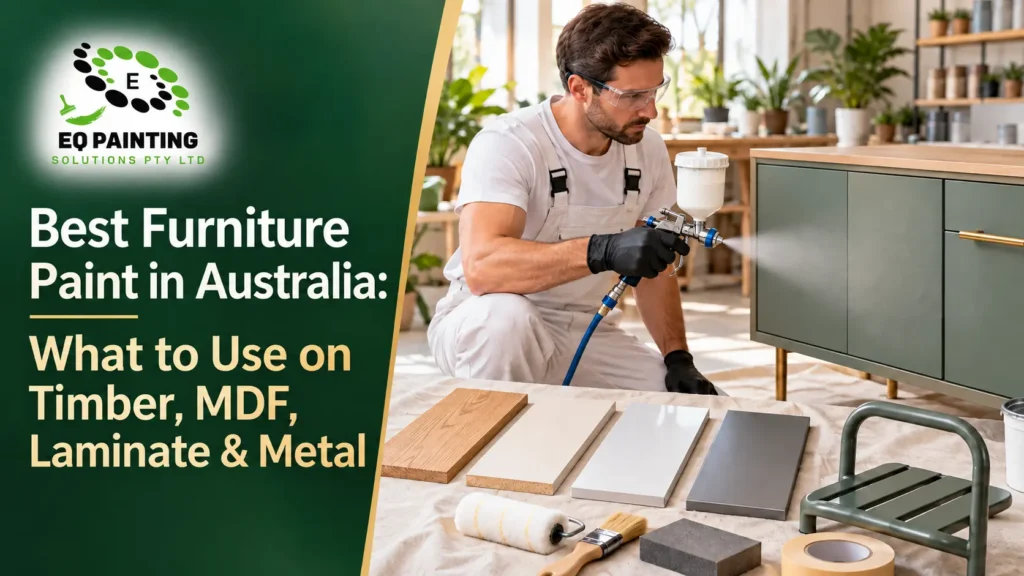
Most furniture paint jobs that fail didn’t fail because of the paint — they failed because the paint never had a chance to stick. We get called to fix flat-pack units in Brunswick rentals where the finish scratched off with a fingernail, and old laminate sideboards someone rolled straight over with leftover wall paint. If you’re hunting for the best furniture paint in Australia, the honest starting point isn’t a brand at all: it’s knowing what your piece is made of, because timber, MDF, laminate and metal each want a completely different approach.
After 15 years painting and spraying furniture across Melbourne, we’ve learned that the “no sanding, sticks to anything” promise on the tin only holds when the surface underneath is right. This guide breaks it down by material — what to use, what to prime, and when it’s genuinely worth getting a piece professionally sprayed instead of brushing it yourself. Get the match right and a painted dresser or set of cabinets can look factory-fresh for years.
Match the Paint to What the Furniture Is Made Of
The single biggest factor in furniture painting isn’t the colour or the brand — it’s the surface. A sealed laminate cabinet, a raw MDF shelf and a solid timber table all take paint differently, and using the wrong system on any of them is how you end up with peeling or chipping within weeks.
Here’s the quick logic before we go material by material:
- Timber: the friendliest surface — takes most paints well over the right prep.
- MDF: porous, thirsty edges — needs sealing or it drinks paint and swells.
- Laminate and melamine: slick and non-porous — lives or dies on a bonding primer.
- Metal: treat any rust first, then use a primer suited to the specific metal before a compatible enamel.
Painting Timber Furniture
For solid timber furniture, a water-based acrylic enamel in satin or semi-gloss is the most practical choice for Australian homes. It dries hard, resists knocks and fingerprints, and — unlike the old oil-based enamels — won’t yellow over time on a white piece. Dulux Aquanamel, and the Haymes and Wattyl acrylic enamels, are all solid picks.
Prep is simple but non-negotiable: clean off grease, give it a light sand for adhesion, and prime any bare or stained timber. Knotty or tannin-heavy woods (pine, some old jarrah pieces you’ll find in a Fitzroy share house) can bleed through a pale topcoat, so seal those with a stain-blocking primer like Zinsser B-I-N first. Two topcoats over primer is standard — one coat rarely levels evenly.
If you want a smoother, brush-mark-free result on a feature piece, that’s usually where spraying pulls ahead of a brush and roller.
Painting MDF and Flat-Pack Furniture
MDF paints up beautifully on the flat faces but has one weakness: the cut edges are porous and soak up paint like a sponge. Seal those edges first — a coat of primer or even a dedicated MDF sealer — or they’ll stay rough and patchy no matter how many topcoats you add.
Once sealed and lightly sanded, MDF takes the same water-based acrylic enamel as timber. Keep coats thin; heavy coats on MDF are slow to dry and can raise the surface. This is the realistic path for most of those flat-pack units — a bookshelf, a TV console, a kid’s desk — that look tired but are structurally fine.
Painting Laminate and Melamine — the Tricky One
Laminate and melamine are the surfaces that catch people out. They’re slick, sealed and non-porous, so standard paint has nothing to grip — it’ll peel the moment the surface gets knocked. The fix is a high-bond adhesion primer designed for slick surfaces. Skip it and the job is doomed before you start.
In Australia you’ve got a couple of reliable routes: a manufacturer-approved high-adhesion bonding primer suited to laminate or melamine (Zinsser B-I-N is one example), followed by a compatible enamel; or a purpose-made system such as White Knight Renew Tile & Laminate Paint used with its matching primer, or the Dulux Renovation range. Clean thoroughly with sugar soap, scuff with 220-grit, prime, then two thin topcoats. This is exactly the system behind repainting laminate kitchen cabinets in Melbourne — and for cabinets that see daily wear, professional spraying with a cabinet-grade coating system gives a harder, smoother and more uniform finish than a typical DIY brush-and-roller job.
Painting Metal Furniture
Metal furniture is straightforward once you match the primer to the metal. Sand back any flaking rust, then prime with a primer suited to the specific surface — a rust-inhibiting primer on steel and iron, or an etch or adhesion primer on aluminium and already-coated metal. That step is what stops rust bleeding back through on ferrous metals. Over the right primer, a water-based or acrylic enamel works well, and spraying gives the cleanest finish on chairs, frames and outdoor pieces with lots of edges and curves.
Chalk Paint vs Enamel: Which Should You Use?
Chalk paint and enamel solve different problems. Chalk-effect paints (like Rust-Oleum Chalked or Gilly’s here in Australia) are marketed as needing minimal prep and give a soft matte, often distressed look — great for decorative pieces. The surface still needs to be clean and sound, and you should follow the product’s own instructions. The catch is durability: chalk paint needs a wax or clear sealer on top, and even then it’s not as tough as enamel on anything that gets daily use.
Acrylic enamel is the harder-wearing option for pieces that actually get used — a dining table, a bench seat, cabinet doors. It resists scuffs and cleans up better. In short: chalk paint for looks on low-use pieces, enamel for durability on everything you touch regularly.
Not sure whether your piece is worth spraying or better to DIY? A quick look tells us — get a free quote and we’ll tell you honestly which pieces are worth the professional finish and which you can happily tackle yourself.
Do You Really Need to Sand? The Primer Question
“No sanding required” is the most misread line in furniture painting. Even paints that skip sanding still expect a clean, sound surface — and on slick laminate or glossy old varnish, a light scuff plus a bonding primer is the difference between a finish that lasts and one that flakes. Sanding isn’t about removing the old finish; it’s about giving the new paint something to key into.
Our rule of thumb: clean everything, scuff glossy surfaces, and prime any bare timber, raw MDF, laminate or metal. If you’re unsure whether your piece needs a primer, our take on whether you need to prime before painting walks through it.
Furniture Paint by Material: Quick Reference
| Material | Prime with | Topcoat | Notes |
|---|---|---|---|
| Solid timber | Suitable primer / stain blocker where required | Acrylic enamel (satin/semi-gloss) | Sand for adhesion |
| MDF | MDF sealer / primer (seal cut edges) | Acrylic enamel | Thin coats |
| Laminate / melamine | High-adhesion bonding primer | Compatible enamel or laminate paint | Prep is critical |
| Metal | Substrate-appropriate metal primer | Acrylic / water-based enamel | Treat rust first |
| Decorative low-use pieces | Self-priming | Chalk-effect paint + sealer | Seal with wax or clear coat |
When to DIY and When to Get It Sprayed
Plenty of furniture is worth a weekend and a brush — a bookshelf, a bedside table, a piece you’re experimenting with. Where it’s worth getting sprayed is when the finish really shows: kitchen cabinets, a glossy feature piece, or anything where brush marks would spoil the look. Spraying lays down an even, factory-smooth coat that’s very hard to match by hand, especially on doors and drawer fronts.
It’s the same reasoning behind spraying internal doors rather than brushing them. If the piece is high-value, high-use or highly visible, the professional finish usually earns its cost.
Related Articles
Planning a furniture or cabinet refresh? These guides go deeper on the decisions above:
Frequently Asked Questions
The Real Takeaway
The best furniture paint in Australia isn’t a single tin you can grab and go — it’s the right system for what the piece is made of. Match the primer and topcoat to timber, MDF, laminate or metal, respect the prep, and even an old flat-pack or a tired laminate cabinet can look genuinely new for years. Skip the primer on a slick surface and no brand will save it.
If you’ve got a feature piece, a full set of kitchen cabinets, or anything where a flawless finish matters, that’s where spraying earns its keep. EQ Painting Solutions sprays and paints furniture and cabinetry across Melbourne — from Hawthorn kitchen renos to one-off pieces in Fitzroy and Brunswick homes — and we’ll tell you honestly which jobs are worth the professional finish. Free quotes across Melbourne. Call 0498 200 654 or request your free quote today.