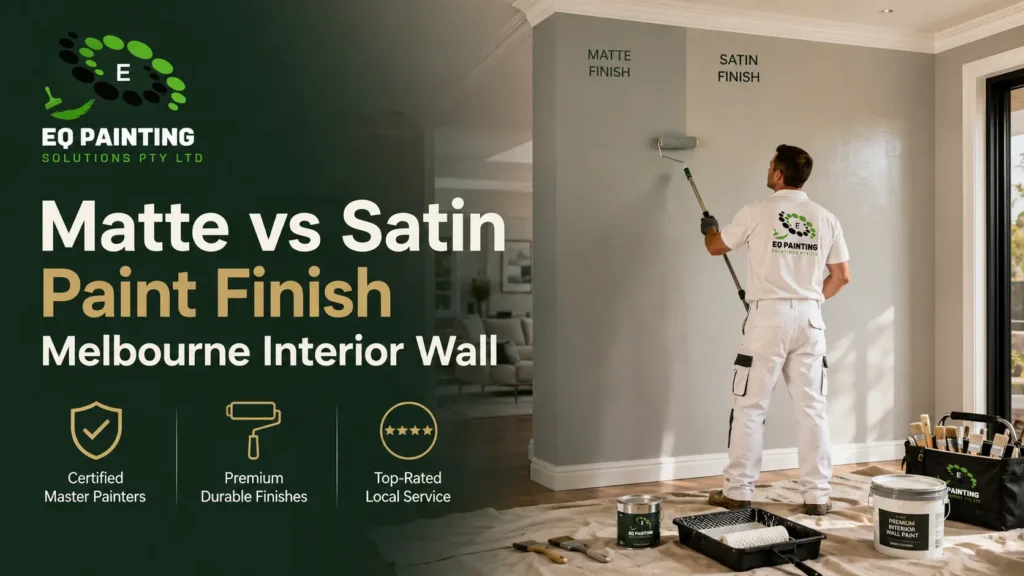
Short answer: for a genuinely humid room, choose satin over matte. But if you’re painting in Australia, there’s a catch worth knowing before you get to the paint counter — most local wall ranges don’t sell a product called “satin” at all. Ask for low sheen, because that’s what satin is called here on wall paint. Satin on an Australian shelf is usually an enamel for doors and trim, not a wall finish.
That naming gap is the single most common reason people walk out with the wrong tin. Here’s how the finishes actually differ, and what we’d specify room by room after doing this across Melbourne interiors in every kind of house from single-brick terraces to new builds.
What the Sheen Levels Actually Mean
Sheen is how much light the dried paint film reflects. Higher sheen means a harder, tighter film — which is what makes it more moisture-resistant and easier to scrub. Lower sheen means a more porous, open film that hides surface flaws but absorbs more.
- Flat / Matte — almost no reflection. Best hiding power for uneven walls and patched plaster. Least washable, and it holds moisture longest.
- Low sheen (this is your “satin” for walls) — a soft, barely-there glow. The practical middle ground: wipes clean, resists moisture reasonably, still forgiving on ordinary walls.
- Semi-gloss — clearly reflective. Very washable and moisture-resistant, but it shows every ripple and repair in the wall behind it.
- Gloss / satin enamel — trim territory. Doors, architraves, skirting, window frames.
The trade-off runs in one direction the whole way up: the better a finish handles moisture and cleaning, the more mercilessly it shows the condition of your wall.
“Humid Australian Environment” Means Two Very Different Things
This is where generic advice falls over. Australia doesn’t have one humidity problem — it has two, and they call for different answers.
Ambient humidity is the Brisbane, Darwin and far north Queensland situation: the air is simply wet, most of the year, everywhere in the house. Whole-of-home moisture resistance genuinely matters there, and mould can appear on a bedroom wall that has no shower anywhere near it.
Condensation humidity is the Melbourne situation, and it’s the one we deal with. The air isn’t especially wet — the surfaces are cold. In a Melbourne July with outdoor averages around 6–14°C, an uninsulated south-facing wall or a ceiling corner sits well below room temperature. Warm, moist indoor air from showers, cooking and drying laundry hits that cold surface and condenses on it. The result looks like a humidity problem, but it’s localised to specific cold surfaces rather than spread through the house.
Why this matters for your finish choice: in Melbourne you generally do not need moisture-resistant paint everywhere. You need it in the wet rooms and on the specific cold surfaces that keep marking, and you can use whatever you like elsewhere. Someone in Cairns has a stronger case for going low sheen throughout.
Room by Room: What We’d Actually Specify
Bathroom, laundry, ensuite. Neither matte nor a standard low sheen. Use a dedicated kitchen-and-bathroom formulation — Dulux Wash&Wear +PLUS Kitchen & Bathroom or equivalent — in low sheen or semi-gloss. These carry mould inhibitors that ordinary wall paint doesn’t, and standard interior paint degrades in a room that gets steamed daily. On a bathroom ceiling specifically, this is not optional.
Kitchen. Low sheen, or a kitchen-and-bathroom product behind the cooktop and sink zone. Splatter and grease need to come off without taking the paint with them.
Hallways, living areas, stairwells. Low sheen. High-traffic walls collect scuffs and handprints, and matte can’t be cleaned without burnishing — rubbing a shiny patch into the flat finish that no amount of further wiping fixes.
Bedrooms. Matte is fine, and often looks better. Low moisture, low contact. The exception is a bedroom with an external wall that goes mouldy each winter — that’s a cold-surface problem, and matte will make it worse. If you’re planning a feature wall, keep it in the same sheen as the rest of the room — a sheen mismatch on one wall reads as a mistake rather than a design choice.
Ceilings. Flat ceiling paint everywhere except bathrooms and laundries. Ceilings show every imperfection under raking light, and any sheen amplifies it.
Trim, doors, skirting. Here’s where you genuinely do want a product labelled satin — a satin or semi-gloss enamel. This is the one place the Australian “satin” label belongs.
Why Matte Fails Faster in Damp Rooms
The mechanism is worth understanding, because it explains why “just use a mould-resistant matte” doesn’t solve it either. A matte film is more open and porous. Moisture settles into it rather than beading on the surface, and it stays there longer. That damp, textured film is a better foothold for mould spores than a tight low sheen film is.
Then there’s cleaning. When mould does appear, you have to be able to wash the surface. Scrubbing matte paint polishes it unevenly and leaves permanent shiny patches, so the usual outcome is that the whole wall gets repainted rather than cleaned. Low sheen takes a fungicidal wash and a cloth without visible damage.
Worth being clear about the limit here, though: no sheen level fixes a moisture problem. If a wall keeps going mouldy, the finish is not the cause. We’ve written separately on what mould-resistant paint can and can’t do, because that misunderstanding costs people a repaint.
Two Things Worth Doing Before You Commit
Test the sheen on your actual wall, not a brochure. Paint a patch at least A3-sized on the wall in question and look at it in the morning, at night under artificial light, and from an angle with light raking across it. Sheen looks completely different under Melbourne’s flat winter light than under a showroom’s downlights, and raking light is what reveals whether low sheen will expose your wall’s flaws.
Check the wall’s condition honestly. If the plaster has been patched repeatedly, has visible joins, or is an old lath-and-plaster surface with waves in it, low sheen will show all of it. In that situation you’re choosing between hiding the flaws with matte and getting the wall properly skimmed first. On heritage interiors, we often recommend the skim — it costs more upfront and it’s the only way to get a durable finish that also looks flat and even.
One more thing that matters more than sheen: coats. The Australian Standard for painting (AS/NZS 2311) calls for a three-coat system. A premium low sheen applied in two thin coats will underperform a mid-range one applied properly.
The Short Version
In a humid room, satin beats matte — and in Australia you should ask for it by its real name, low sheen. In a wet room specifically, skip both and use a kitchen-and-bathroom formulation. Keep matte for bedrooms, ceilings and walls whose condition needs hiding. And if you’re in Melbourne rather than the tropics, remember that your humidity is probably condensation on cold surfaces, which means fixing ventilation will do more for you than any tin of paint.
Related Articles
Frequently Asked Questions
Not Sure Which Way to Go?
Sheen choice is easy to get wrong in a way you only notice six months later, when the hallway won’t wipe clean or the bathroom ceiling starts spotting. If you’re weighing it up for a specific room, we’re happy to look at the wall and tell you what we’d use and why.
Call 0498 200 654 or request a free quote. We work across Melbourne — bayside, eastern, inner-north and western suburbs.
Pingback: Best Interior Paint Australia: Walls, Ceilings & Trim