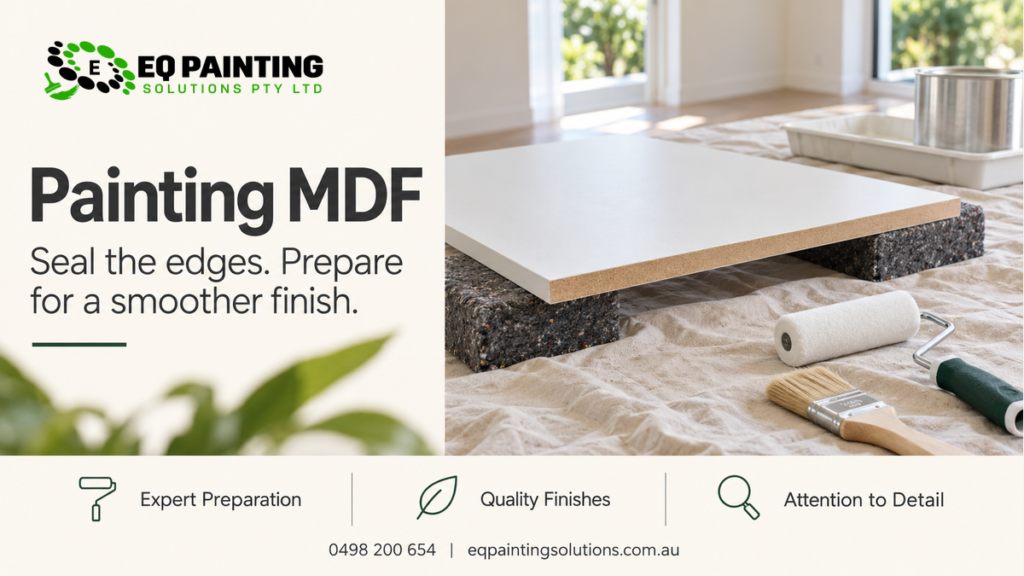
Painting MDF starts with a dry, sound board and a coating system suited to its actual surface. Prepare the faces gently, seal absorbent cut edges as the system requires, then prime and apply a compatible finish. Do not soak the board, bury rough fibres under heavy paint or expect a new coating to repair swollen, crumbling material.
A shelf can look smooth across its face yet feel furry along the front edge. That edge needs attention before colour goes on. This guide explains the preparation decisions for MDF furniture, panels and cupboard doors; our spray painting service in Melbourne can help you discuss suitable furniture and cabinet work.
First, identify what you are actually painting
MDF is medium density fibreboard, made from wood fibres bonded into a panel. The visible surface may be raw fibreboard, a factory primer, an existing paint film or a decorative covering. Those surfaces do not all need the same preparation.
- Raw MDF: the exposed faces and cut edges need an approved sealing and painting approach.
- Factory-primed MDF: check the supplier’s finishing instructions, the primer’s condition and any newly exposed cuts.
- Previously painted MDF: check that the coating is firmly attached and compatible with the proposed repaint.
- Laminate, melamine or vinyl-covered board: identify the covering before selecting an adhesion system. The MDF core does not make its outer surface absorbent.
Inspect corners, the lower edges of doors and areas around fittings. A coating change is one decision; a loose covering, soft edge or distorted panel is another. Do not sand through a decorative face to turn an unidentified surface into raw MDF.
Is the board sound enough to paint?
Paint only a board that is suitable for its location and in sound condition. Raised fibres after preparation are different from a panel that has become thicker, soft or misshapen after moisture exposure.
Check for damp storage, leaks, repeated splashing and loose fibres that keep breaking away. Resolve the moisture source before considering a finish. Widespread swelling, crumbling edges or damage around hinges may need assessment by a cabinetmaker or replacement rather than cosmetic filling.
New boards should be stored and conditioned as their supplier requires. MDF responds to surrounding moisture, so moving a damp panel straight into a heated room does not establish that it is ready. Obtain the relevant readiness requirements instead of relying on a fixed number of days.
Set up dust control before sanding MDF
MDF sanding produces fine wood dust. Plan to capture it where it is generated, keep other people away from the work area and protect nearby belongings before starting.
WorkSafe Victoria recommends on-tool extraction for portable tools and suitable industrial vacuum equipment, with a minimum Dust Class M recommendation. A small dust bag alone does not efficiently capture fine dust. Do not clear the bench or clothing with compressed air.
Use the respiratory, eye and other protection appropriate to the task, alongside dust controls. Follow the board and coating safety information. Ventilation is also needed for paint and solvent vapours, but an open window does not replace dust extraction.
For previously coated items or adjoining old woodwork, assess suspect paint before disturbing it, particularly in pre-1970 buildings. The age of the house does not prove that a particular MDF panel contains lead; the coating history and any other surfaces being disturbed still matter.
Prepare the faces without grinding them away
Remove hardware where practical and support removable panels securely. Label components so they can return to the correct position, and protect hinges, runners and areas that should remain unpainted.
Clean existing coatings using a method compatible with the surface and proposed system. Raw MDF is not a surface to flood with cleaner or water. Follow the supplier’s cleaning and residue-removal requirements, and allow the board to meet its drying requirements before coating.
Fill sound, minor surface defects with an approved compatible filler, allowing it to dry before smoothing. Use light, controlled sanding where required, checking the face under angled light. Aggressive sanding can change a flat surface or soften a crisp profile.
Choose abrasives for the board, defect and coating stage. A grit used to remove a machining mark is not automatically right for smoothing dried primer. Remove dust using suitable extraction and the coating supplier’s approved final-cleaning method.
How do you seal MDF edges for painting?
Seal exposed cut edges with a product approved for the MDF and the finishing system. The aim is to control absorption and provide an even base, rather than trying to hide a porous edge with a thick topcoat.
Inspect routed profiles, corners and fresh cuts as well as the obvious outer edges. First smooth loose fibres and machining marks without changing the intended shape. Apply the specified sealer or primer, let it dry as directed, then lightly smooth raised fibres if required.
Reinspect before proceeding. Where sanding exposes raw board again, restore the specified coating coverage. A rough patch still visible at this stage needs attention before the finish coats.
Some systems use a separate edge sealer; others provide the required sealing through an approved primer sequence. Ask the manufacturer whether an additional product is needed. Do not assume a homemade diluted-glue mix will work with every later coating.
Does MDF always need an oil-based primer?
No. MDF can be painted with an approved water-based or solvent-based system. Choose the complete compatible system for the actual board and use, rather than deciding from the words “water-based” alone.
For example, the Dulux 1 Step Prep technical sheet lists MDF among its suitable substrates. That is a manufacturer example, not a statement that EQ uses that product on every job. Confirm the applicable preparation and topcoat requirements for your particular project.
Do not dilute a primer, dampen raw board or substitute a generic wall undercoat based on a general online recipe. Follow instructions that apply to MDF and obtain clarification where a product’s general porous-surface advice is unclear.
For broader product choices across different furniture materials, see our guide to furniture paint in Australia. This MDF guide focuses on preparing the board and its edges.
Check the primer before adding colour
Wait until the coating is ready for its next preparation or painting stage. A surface that feels dry can still be unsuitable for sanding or recoating; use the selected product’s instructions and account for the actual room conditions.
Where specified, lightly remove dust nibs or raised fibres from the dry primer. Avoid cutting through at corners. Check the whole panel in good light, remove the sanding dust and deal with missed or exposed areas before topcoating.
An offcut or inconspicuous trial area is useful for checking the intended sequence and appearance before committing to every door. Use the manufacturer’s assessment method; a freshly dried patch does not establish long-term durability.
Choose the finish and applicator around the job
A cupboard door, decorative panel and heavily used shelf have different demands. Select a topcoat approved for that use and for the primer beneath it. Do not assume ordinary wall paint will provide the required resistance to handling or cleaning.
Use the brush, roller or spray method specified for the selected coating. A roller can suit accessible flat panels, while brushing helps with details. Spraying requires suitable equipment, masking and exposure controls; it does not remove the need to prepare the edges.
Apply each coat at its specified coverage and build. An overly heavy coat is not a shortcut to the required finish. Plan where panels will rest while drying so painted faces do not touch supports or each other prematurely.
Allow the finished coating to reach its specified handling and cleaning readiness before refitting, stacking items on shelves or using cleaners. Recoat time and full cure are different stages, and cool or humid Melbourne conditions can affect the schedule.
What if the edges turn rough or the board swells?
- Fine raised fibres: let the applied product dry as directed, then assess whether controlled smoothing and further approved sealing will provide a sound base.
- Scratches or uneven sanding: correct the preparation before adding colour; more paint is not a reliable way to level a damaged profile.
- A thickened or soft edge: stop and investigate moisture and board condition. Do not keep sanding a panel that is breaking down.
- Peeling paint or a lifting covering: identify the failing layer and its cause before choosing a repaint system.
If you cannot tell whether you are seeing a coating defect or board damage, get advice before removing more material. The appropriate repair depends on the condition, location and intended use.
Does painted MDF become waterproof?
No. Painting ordinary MDF does not turn it into a waterproof board. Moisture-resistant grades also need the correct application and finishing details; the label is not permission for prolonged wetting.
For bathroom furniture, check that both the board grade and coating system suit the location and likely exposure. For outdoor use, obtain explicit approval for the particular board and complete finish. Do not transfer an indoor cupboard method to an exposed exterior panel.
Plan the specified treatment of faces, edges, backs and new cuts before installation makes them difficult to reach. Coating only the visible front is not a complete moisture-protection plan. Existing leaks or unsuitable construction need attention beyond painting.
When should you call a painter?
Ask for advice on large sets of doors, detailed profiles, uncertain existing coatings or a finish where preparation marks will be conspicuous. Damaged cabinetry may need a cabinetmaker’s assessment before a painter can agree a suitable scope.
EQ Painting Solutions provides furniture, timber and spray painting across Melbourne and surrounding suburbs. Discuss the surface condition, preparation, agreed repairs, colour and finish before work is arranged. You can ask about your MDF painting project without committing to an unverified product system or completion date.
Related Articles
These guides cover product selection and related preparation decisions:
- Best Furniture Paint in Australia: Choosing by Material
- Painting Skirting Boards Without Brush Marks
- Do I Need to Prime Before Painting?
- How Long Should Paint Dry Between Coats?
Serving Melbourne suburbs
For furniture and interior painting enquiries, explore our local service information:
Frequently Asked Questions
Raw MDF generally needs an approved sealing and priming sequence before its finish coats. A factory-primed board may already have part of that preparation, but cuts, defects and the primer's suitability still need checking. Follow the board and paint manufacturers' instructions.
Choose a finish suited to the furniture's use and compatible with its primer. A decorative panel and a shelf exposed to repeated cleaning may need different performance. Identify any existing paint or covering before selecting the system.
Yes, where the manufacturer approves it for the MDF and intended coating system. Water-based does not automatically mean unsuitable. Follow the applicable application directions rather than adding water or using a generic primer recipe.
Prepare the cut edge, seal it with an approved product and check it after drying. Lightly smooth raised fibres where required, then restore any exposed coating coverage. Do not rely on thick finish coats to conceal a rough base.
It depends on the board's condition, factory preparation and selected finish. Sand defects or rough areas only as needed and follow the specified preparation sequence. Avoid aggressive sanding of an already smooth face, and capture the dust at its source.
Moisture exposure can change the board's dimensions, particularly where protection is incomplete. Check for dampness, excessive wetting and existing damage rather than assuming every rough edge is swelling. Soft or distorted material needs assessment before more paint is applied.
Yes, if the board and retained coating are sound and suitable for overcoating. Clean and prepare the surface as the new system requires, checking an appropriate trial area. Loose paint, contamination or underlying board damage must be addressed first.
Potentially, using a system approved for the actual covering. Prepare the exposed laminate or melamine as that surface requires; a raw-MDF primer method is not automatically suitable. Lifting vinyl or a damaged covering needs separate assessment.
Use the coat count and coverage specified for the complete system. Absorbent edges may require additional preparation before the finish can look even. Check the prepared surface rather than treating one coat count as correct for every board and product.
Either can suit an appropriate product and project. Rolling is practical for some flat panels; spraying can suit detailed components or larger sets with the necessary setup and controls. The condition and preparation of the board still determine the base you are coating.
No. A painted finish does not convert ordinary MDF into a waterproof material. The board grade, exposure, construction and treatment of all required surfaces must suit the location. Resolve leaks and repeated wetting rather than relying on another coat.
Only where the board manufacturer approves that application and a suitable finishing system is used. Moisture-resistant is not the same as waterproof. Confirm the expected splash exposure and treatment of edges, backs and cuts before installing or repainting it.
Give the edges the same attention as the face
A good MDF repaint starts with identifying the surface, checking that the board is sound and following a compatible preparation and coating sequence. Resolve roughness before the topcoat, and treat moisture damage as a condition problem rather than a colour problem.
For MDF furniture, cupboard doors or other agreed painting work across Melbourne, call EQ Painting Solutions on 0498 200 654 or request a free quote. The preparation and finish can then be discussed for your project.