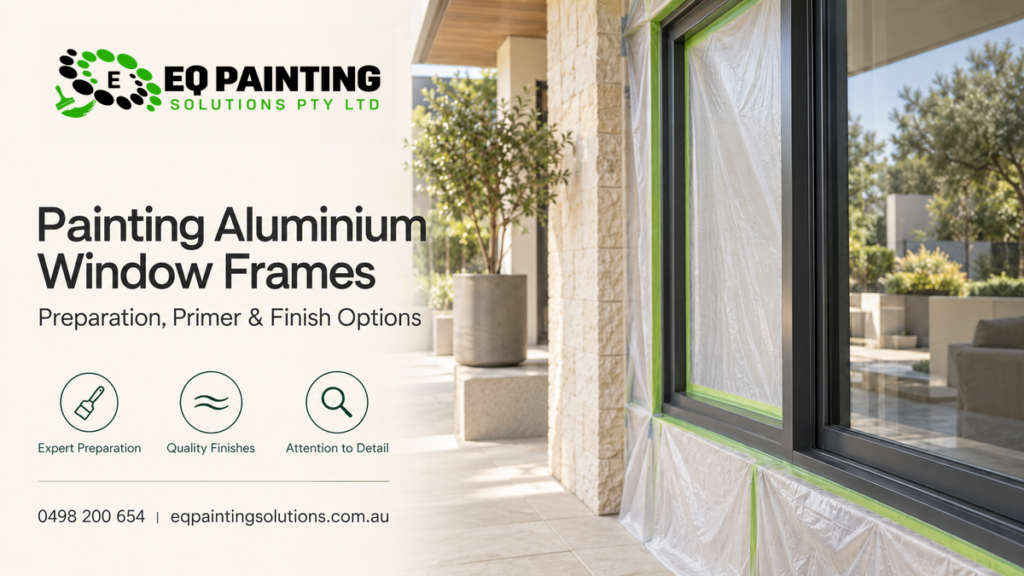
Painting aluminium window frames is possible when the frames are sound, the existing finish is identified and the coating system is suitable. Start by checking the window manufacturer’s advice, then clean, prepare and test the surface before priming and painting. Protect the glass, seals, tracks and drainage openings, and allow the specified drying time before using the windows.
A colour change can give otherwise serviceable windows a fresh appearance, but the paint has to bond to the surface already there. Bare aluminium, powder coating and an anodised finish need different decisions. This guide explains the preparation and finish options to consider before discussing a project with our spray painting service in Melbourne.
Should you repaint the frames or leave the original finish?
Check the window manufacturer’s care instructions before changing the finish. Some manufacturers advise against painting their aluminium frames because it can affect the original coating warranty and window operation. A site repaint also should not be described as equivalent to the original factory finish.
Start with the practical problem you want to solve. If the frame is sound and the concern is colour, repainting may be worth assessing. If there is damaged glazing, a failing seal, significant corrosion, water entry or a window that will not operate properly, get the window problem assessed first. Paint does not repair those faults.
For a small scratch in an otherwise good original finish, ask the window supplier about an approved touch-up option. For apartments or an owners corporation property, check the applicable approval process before changing an external frame colour.
What surface are you actually painting?
The visible finish matters as much as the metal underneath it. A frame that looks metallic may still have a factory finish, so appearance alone is not enough to identify the substrate for a primer.
| Existing surface | What to check | Preparation and primer decision |
|---|---|---|
| Bare aluminium | Exposed metal, oxidation and contamination | Prepare the metal and use the aluminium primer specified for the selected topcoat. |
| Sound powder coating | Whether the old coating is firmly attached | Clean and prepare the retained coating; obtain a compatible repaint specification. |
| Anodised finish | Confirm the finish with the window supplier | Ask for a system approved for that surface and carry out the specified compatibility test. |
| Previously repainted frame | Loose paint, edges and compatibility of older layers | Resolve failed layers and test the proposed system before coating the whole frame. |
If powder coating is peeling or poorly bonded, putting stronger paint on top will not make the underlying coating sound. Dulux’s powder-coating repaint guidance calls for checking adhesion and removing coating that fails the test. Ask a painter to assess widespread failure rather than sanding everything back as a first step.
How do you prepare aluminium window frames?
1. Plan protection and safe access
Decide which faces of the frame will be painted, how the window opens and where masking can be placed. Note the edges that disappear when the sash closes. Leave glass removal, damaged seals and window dismantling to an appropriate specialist; do not take a window apart simply to make painting easier.
In an older home, check surrounding painted timber and other coatings for lead before sanding or scraping. Lead-based paint was commonly used on pre-1970 buildings, but the age of the building alone does not confirm its presence. If lead is suspected, stop ordinary dry sanding and get advice on testing and controlled preparation.
2. Clean before preparing the surface
Remove dirt, grease and other contamination using a cleaner permitted by the window and coating manufacturers. Rinse as directed and let the frame dry. Powder-coated finishes can be damaged by aggressive solvents, so do not assume acetone or paint thinner is a suitable cleaner for every frame.
Cleaning advice for maintaining the original finish and preparation advice for deliberately recoating it serve different purposes. Confirm the repaint specification before using an abrasive or chemical product. Coastal salt deposits and built-up dirt should be addressed before testing adhesion.
3. Check adhesion and prepare only what is needed
Once the finish is identified, follow the coating supplier’s preparation method. For a firmly attached powder coating, this may involve controlled abrasion to remove gloss and create a suitable surface. Remove preparation dust before painting.
Do not use one sandpaper grit as a rule for every finish. The amount of abrasion, treatment of exposed metal and management of old paint edges depend on the actual coating. Deep scratches and poorly feathered edges can remain visible through a new finish.
4. Mask the parts that must keep working
Protect the glass, rubber seals, weather strips, locks, handles and adjacent walls. Keep paint out of sliding tracks, moving hardware and drainage openings. Some drainage holes are concealed under the sill, so locate them before masking or painting.
Drainage holes let collected water escape to the outside. They must remain open after the job; do not fill them with paint or sealant. If spraying is proposed, protection also needs to control overspray beyond the frame itself.
5. Test the full coating system
Use a small inconspicuous area for the manufacturer-specified compatibility and adhesion check. Test the proposed preparation, primer and topcoat together, then allow the required drying period before assessing the result. If the coating lifts, wrinkles or does not bond, resolve that before painting every window.
Which primer should you use on aluminium?
Choose the primer for the exact surface and topcoat, rather than choosing a tin simply because it says “metal”. Bare aluminium and intact powder coating are not interchangeable surfaces.
For example, Dulux Metalshield RFU Etch Primer lists aluminium among its suitable metal substrates, but its instructions say it must not be applied over existing painted surfaces. Dulux’s technical note on repainting powder and coil coatings also advises against an etch primer over those coatings.
A different product system may call for a different primer. The current Dulux Metalshield Epoxy Enamel Satin instructions specify Metalshield All Surface Primer for aluminium. An adhesion primer can be another option for a suitable retained finish, but its label, compatibility limits and test requirements still apply.
These are technical examples; the product system for your windows must be agreed for the project. Ask for the proposed preparation and coating system to be agreed for your frames. Our primer versus undercoat guide explains why those terms are not automatically interchangeable.
Is brush painting or spray painting more suitable?
A brush can suit narrow sections or a small project where the selected coating permits brush application. Spraying can suit detailed profiles or several frames, but it requires more extensive protection and control of spray mist. Neither method compensates for poor adhesion or an unsuitable primer.
- Brush: consider access to corners, the brush recommended for the coating and whether visible brush marks are acceptable.
- Spray: consider overspray, room protection, ventilation, nearby people and the product’s safety requirements.
- Either method: follow the specified coverage, coat thickness and recoat instructions; avoid heavy build-up around operating clearances.
Spraying is not automatically a safe DIY shortcut. Read the safety data sheet and use the required exposure controls. Isocyanate-containing two-pack coatings need specialist controls; an ordinary dust mask is not adequate protection for that work. Product choice and application method should be assessed together.
If you are unsure how to protect the room or choose a compatible system, discuss the frames and finish you want with EQ Painting Solutions before starting.
What finish and colour should you choose?
Choose a topcoat specified for the prepared substrate and its interior or exterior exposure. Do not assume a general wall paint is approved for an aluminium window frame. A compatible enamel or other coating may be suitable when the complete system is confirmed.
Satin, semi-gloss and gloss are options to discuss where the chosen product offers them. Compare a real colour and sheen sample near the wall, glass and adjacent trim. Black, charcoal and white can produce quite different visual effects, and a liquid repaint may not exactly match a factory coating with the same colour name.
For an external colour change, check the window supplier’s restrictions and the surrounding facade palette. EQ provides colour advice as part of the free quote conversation; the final finish should be agreed for the actual surface and project.
How long should primer and paint dry?
Follow the instructions for the exact products and conditions. Touch dry, ready to recoat and ready for normal use are different stages. Do not close a newly painted sash simply because the exposed face feels dry.
For a specific example, Dulux Precision Maximum Strength Adhesion Primer lists a one-hour minimum recoat interval under its stated conditions. Its data sheet gives additional requirements for certain topcoats, including 24 hours before epoxies, lacquers or products containing “hot” solvents. The same data sheet says full adhesion strength develops over seven days.
That example is not a timetable for all aluminium frame projects. The primer, topcoat, film thickness and site conditions determine the waiting periods. Allow for cool Melbourne mornings, condensation, rain risk and hot sun, and check the permitted surface temperature as well as the air temperature.
Before normal use, remove masking at the appropriate stage, confirm drainage remains open and check that the window operates without fresh paint sticking at contact points. Follow the coating supplier’s cure and cleaning advice.
What affects the cost, and when should you call a painter?
Aluminium window frame painting should be priced for the actual job. The number and size of frames, internal versus external faces, access, condition of the old coating, masking, colour change and proposed system all affect the work. A tailored quote is more useful than a generic per-window rate because preparation and access vary.
A painter’s assessment is particularly useful for an unknown factory finish, several peeling layers, extensive masking, upper-storey access or a proposed spray application. Window damage and operational faults may need a window specialist before painting can be considered.
EQ Painting Solutions offers metal, exterior and spray painting across Melbourne and surrounding suburbs. You can discuss whether spray painting suits your project, including preparation, colour and access. Scope and start dates depend on the agreed work, availability and site conditions.
Related Articles
These guides explain the preparation, application and drying decisions behind a repaint:
- Primer vs Undercoat: What Is the Difference?
- Spray Painting vs Roller: Which Finish Is Better?
- How Long Should Paint Dry Between Coats?
Serving Melbourne suburbs
We serve Brighton, Port Melbourne and Caroline Springs. For a coastal property, ask about exposure when discussing the coating system. At any address, the frame’s actual finish and condition determine the preparation; these suburbs are service areas.
Frequently Asked Questions
Yes, many sound frames can be repainted with a compatible system. Check the window manufacturer's instructions first, identify the existing finish and test the proposed preparation, primer and topcoat before coating every frame.
Use a topcoat approved for the prepared surface and its interior or exterior exposure, with the primer specified for that system. Bare aluminium and an existing factory finish can require different products. A general wall paint is not automatically suitable.
It may be possible if the coating is firmly attached and the window supplier permits repainting. Check adhesion, prepare the coating as specified and obtain a compatible repaint system. Do not assume an etch primer designed for bare metal belongs over intact powder coating.
Ask the window and coating suppliers for a system suitable for the confirmed anodised finish. Do not treat a bronze, gold or silver factory finish as bare aluminium solely because it looks metallic. Compatibility testing matters before a full repaint.
Only when the chosen system and the surface condition permit it. Some adhesion primers reduce sanding on suitable glossy surfaces, but cleaning and an adhesion test remain important. Loose paint or a failed factory coating still needs assessment and preparation.
Yes, if the primer and topcoat permit brush application. A suitable brush can work on narrow frame sections, although the finish depends on the coating and application. Spraying is another option, with additional overspray and exposure controls.
A colour change may be possible once the existing finish and a compatible system are confirmed. Check a real colour and sheen sample, and ask about window-supplier restrictions before painting external faces. Do not expect a liquid repaint to exactly reproduce a factory powder-coated finish.
Yes, where a suitable system is specified for each exposure and repainting is permitted. Confirm which faces are included, protect the interior and plan safe exterior access. Check drainage, operating clearances and seals on both sides.
Do not remove glazing as a routine DIY preparation step. Whether painting can be done with the glass in place depends on access and protection of the glass, seals and operating parts. If dismantling or seal work is needed, involve an appropriate window specialist.
Follow the coating supplier's instructions for contact surfaces and normal use, rather than a universal number of hours. Paint can feel dry while still being vulnerable to sticking or marking. Temperature, coat thickness and the selected system affect that timing.
The price depends on frame numbers, size, access, coating condition, masking and the proposed finish. Request a free quote for the actual scope, including which internal and external faces need painting.
It can. Some window manufacturers advise against painting their aluminium frames and say doing so affects the original warranty. Check the conditions for your actual windows before altering the factory finish; this is separate from any painting contractor's terms.
A sound repaint starts with the surface
The useful question is not just whether aluminium can be painted, but whether your existing finish can support the proposed system. Identify that finish, check the window manufacturer’s advice and agree the preparation, primer and topcoat before choosing the final colour.
To discuss aluminium window frame painting across Melbourne and surrounding suburbs, request a free quote from EQ Painting Solutions or call 0498 200 654.