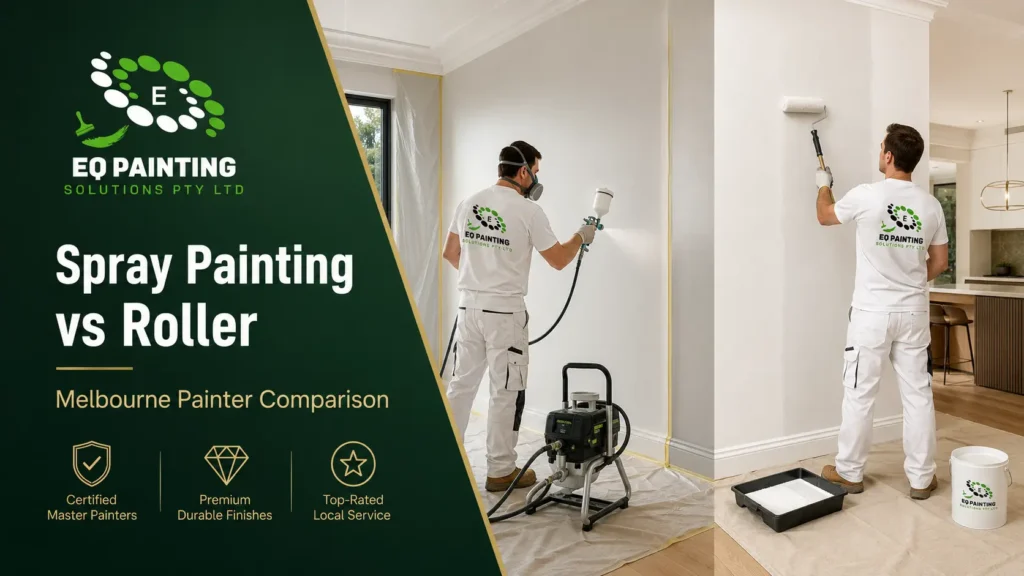
Here’s the honest answer most guides dance around: for a typical occupied Melbourne home repaint, we roll. For a new build, a full exterior, a fence, or cabinets, we spray. Neither method is “better” — they’re built for different jobs, and picking the wrong one costs you time, paint, or a finish you’re not happy with. Spraying is fast and can produce an exceptionally smooth finish; rolling gives excellent control, creates little overspray and usually needs far less masking. This guide breaks down the real trade-offs on spray painting vs roller — speed, finish, paint usage, prep and cost — the way a painter weighs them on site, so you can match the method to your project. If you already know you want it sprayed, our spray painting service in Melbourne covers how we approach it.
The Short Version
Spray painting atomises paint into a fine mist through an airless or HVLP gun, laying down a smooth, even film with no brush or roller marks. It’s fast — a sprayer covers a large area quickly — and it gets into texture, profiles and tight detail a roller can’t. The catch is masking: everything you don’t want painted has to be covered, and overspray drifts. For large walls and exteriors, painters typically use airless spray equipment. HVLP systems are more commonly suited to finer-detail finishing such as cabinetry, doors and joinery.
Rolling is the method most people know. Nearly all the paint on the roller ends up on the wall, so there’s very little waste, the masking is minimal, and you’ve got precise control. The downside is speed on big areas, and a slight stipple texture that a sprayed finish doesn’t have.
Spray vs Roller at a Glance
| Factor | Spray Painting | Roller Painting |
|---|---|---|
| Application speed | Faster on large open areas | Slower on large areas |
| Finish | Very smooth when applied correctly | Light roller texture |
| Masking | Extensive | Minimal |
| Overspray risk | Higher | Very low |
| Occupied rooms | Less convenient | Usually more practical |
| Cabinets & detailed work | Excellent | Less suited |
| Large exteriors | Very efficient | Practical for smaller sections |
Finish Quality: Spray Wins on Smooth, Roller Wins on Texture
If you want a glass-smooth, factory-look finish — on doors, cabinets, trim or a feature ceiling — spraying is hard to beat. It eliminates the fine stipple a roller leaves behind, which is why we spray cabinetry and joinery almost every time.
But on already-textured walls, rolling often gives a more even result, and the light roller texture is usually invisible once the wall’s dry and the light’s on it. For standard interior walls in a lived-in home, a well-rolled finish looks completely professional — you’re not sacrificing quality by rolling, you’re trading a barely-visible texture for a lot less masking.
Speed and Paint Usage: The Real Trade-Off
Spraying is dramatically faster on large, open surfaces — a bare new-build interior or a full house exterior can be a fraction of the time a roller would take. That’s the main reason we spray big empty jobs.
The hidden cost is paint. Spraying can use more paint than rolling because some material is lost to overspray, although the difference varies with the sprayer, pressure, tip size, surface and technique. Rolling, by contrast, puts almost everything on the surface. So on a small job, the speed saving from spraying gets eaten up by masking time and wasted paint. If you’re working out quantities either way, our guide on how much paint you need walks through the coverage maths.
Prep and Mess: Where Rolling Earns Its Keep
This is the factor DIYers underestimate most. Spraying needs everything masked — floors, windows, fixtures, skirting, and in a tight Melbourne suburban block, often the neighbour’s fence and car too, because overspray drifts on a breezy day. That masking can take longer than the painting.
Rolling needs a drop sheet and some tape, and you’re going. For an occupied home where furniture’s still in and you want the job contained to one room at a time, rolling is simply more practical. It’s a big part of why, for everyday interior repaints, the roller stays in our hand.
What the Pros Actually Do: Spray and Backroll
On some large, porous or textured surfaces, painters combine spraying with backrolling. The spray applies the coating quickly, while the roller helps work it into the surface, even out the film and achieve the finish required by the coating system. Whether backrolling is needed depends on the substrate and product specification. It’s the kind of call we make job by job, based on the surface, the access and the finish you’re after. For a full exterior, that decision matters — our exterior house painting approach leans on it.
So Which Should You Choose?
Quick guide:
- Spray — new builds and empty rooms, full exteriors, fences, decks, cabinets, doors and trim, anywhere you want a very smooth finish and there’s little to mask around.
- Roll — occupied homes, single rooms, accent walls, textured surfaces, and any job where control and low mess matter more than raw speed.
For most homeowners repainting a room or two, a roller is the right tool. For a whole-house exterior or a cabinet respray, spraying earns its keep. If you’re not sure which your job calls for, that’s exactly the kind of thing we sort out in a quote — get in touch and we’ll tell you straight which method suits the surface and your budget.
Related Articles
More from our Melbourne painting team:
Frequently Asked Questions
Spraying is fast and leaves a smooth, mark-free finish, but it needs heavy masking and generally uses more paint. Rolling wastes almost no paint and needs little masking, but it's slower on big areas and leaves a slight texture. Spray suits large or empty spaces; roll suits occupied rooms.
Spraying gives the smoother finish. Atomising the paint into a fine mist lays down an even film with no roller stipple or brush marks, which is why it's the go-to for doors, cabinets and trim. Rolling leaves a light texture that's usually invisible on a dry wall but noticeable next to a sprayed surface.
For a full exterior, spraying is usually faster and reaches texture and profiles well — often combined with backrolling to work the coating into the surface. Rolling suits smaller exterior sections or tight blocks where overspray onto a neighbour's property is a risk. The best choice depends on the surface and access.
Spraying generally uses more, because some of the atomised mist is lost to overspray rather than landing on the surface. How much more varies with the sprayer, pressure, tip size, surface and technique. Rolling transfers almost all the paint from the roller to the wall, so on smaller jobs it's usually the more economical method.
Often yes. Sprayers get into the gaps, profiles and rough grain of fences and decking far faster than a roller or brush can, giving even coverage on awkward surfaces. Many painters spray then backroll or backbrush timber to work the coating in for better penetration and durability.
Sprayers handle most water- and oil-based paints. Whether paint needs thinning depends on the coating and spray equipment — many paints designed for airless application can be sprayed without thinning, so always follow the product data sheet and sprayer specifications. Cabinet and trim enamels spray beautifully; textured masonry coatings are often rolled.
Spray painting creates airborne paint mist, so respiratory, eye and skin protection needs to be selected for the coating being used and the conditions on site. Always follow the product SDS and equipment guidance. Roller application generally creates less airborne mist, but appropriate PPE and ventilation are still required.
On large, open surfaces spraying can be several times faster than rolling for the application itself. But that saving shrinks once you factor in masking and cleanup, which spraying demands far more of. On small or cluttered jobs, the total time can end up similar or even favour rolling.
It depends on the job, not the tool. Spraying can be cheaper on large open areas where speed wins, but the extra masking, paint usage and skill can push small-job pricing up. A good painter quotes on the whole job — surface, prep and finish — and picks the method that delivers the result efficiently.
The spray painting vs roller debate doesn’t have a single winner — it has a right tool for each job. Spraying delivers speed and an exceptionally smooth finish on large, smooth or detailed surfaces; rolling gives control, low waste and minimal mess on occupied rooms and textured walls. The professionals’ secret is that they don’t pick a side — they match the method to the surface, and often combine both.
If you’d rather not guess which your project needs, we’ll make the call for you and do it properly. Get in touch for a free quote — free quotes across Melbourne, spray or roll, whichever suits your job. Call us on 0498 200 654.