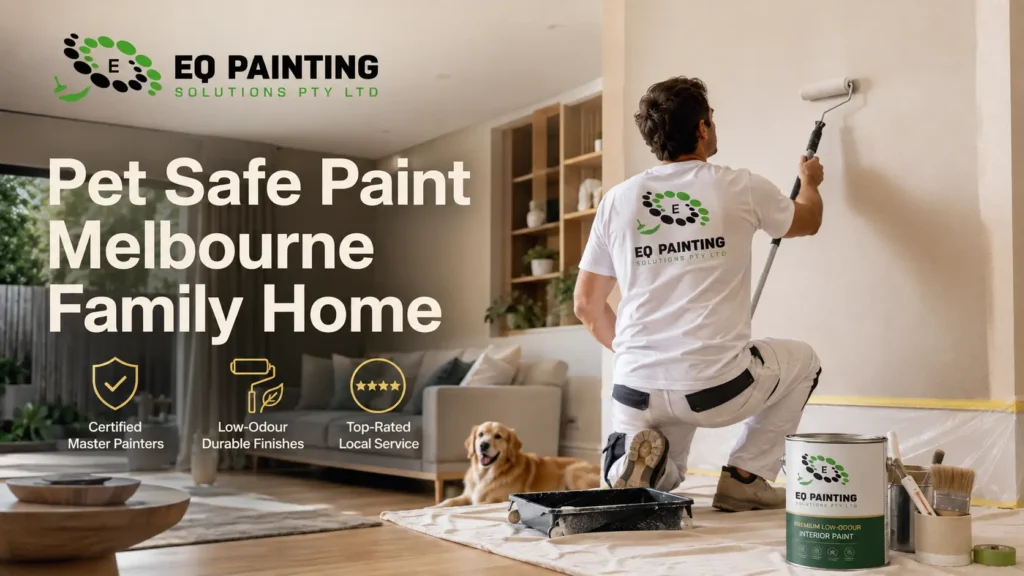
Most paint questions from Melbourne families start the same way. A toddler has just discovered textas, or the dog has worked out that the hallway wall is an excellent place to shake off after a wet walk. So people go looking for pet safe paint and land on a wall of brand names with no real explanation of what makes one safer than another.
Here is the short version, and it surprises people. Almost every premium water-based interior paint sold in Australia today is low-VOC and perfectly fine around children and animals once it has dried. The thing that actually matters is not which tin you buy. It is the finish you choose, the prep work underneath it, and what you do with the house during the two days it is being painted.
After 15 years painting family homes across Melbourne, we have seen far more harm come from sanding an old wall badly than from anything sold in a paint aisle. This guide covers what to buy, what finish to ask your interior painters in Melbourne for, and the one prep risk that genuinely deserves your attention.
What “Pet Safe Paint” Actually Means
Pet safe paint, in a home context, means a water-based interior wall paint with low or zero VOC content that is non-toxic to animals and children once cured. It is not a special product category with its own certification. It is a description of what most quality water-based paints already are.
Search that phrase and half the results will be about paint you apply to a dog: paw-print kits, pet-safe paint pens, craft paints. That is a completely different product. If you are painting a bedroom, a hallway or a kennel, you want interior wall paint, not animal body paint. The two are never interchangeable, and no wall paint should ever go on an animal.
Why the Brand Matters Less Than You Think
Every major Australian brand now sells a low-VOC water-based interior range. Dulux, Taubmans, Haymes and Wattyl are all in the same broad safety territory. What separates them is scrub resistance, coverage and how well the film holds up to repeated cleaning, not toxicity.
| Range | What it is good at | Worth knowing |
|---|---|---|
| Dulux Wash&Wear | Everyday washability in high-traffic rooms | The +PLUS Kitchen & Bathroom version adds mould resistance for wet areas |
| Taubmans Endure | Stain resistance and scrubbing | Holds up well in hallways and stairwells |
| Haymes Expression | Colour depth and coverage | Australian-owned; good for feature walls |
| Wattyl I.D Advanced | Solid all-rounder | Often the value pick when budget is tight |
If a salesperson tells you one of these is “the pet-safe one” and the others are not, they are selling, not advising. Read the tin for the VOC figure and the sheen level instead.
The Finish Decides Whether You Can Actually Clean It
This is where most families go wrong, and it has nothing to do with safety. A flat or matt wall cannot be scrubbed. Rub at a crayon mark hard enough to shift it and you will burnish the paint, leaving a shiny patch that is more obvious than the crayon was.
In Australia, the washable wall finish you want is labelled low sheen, not satin. Satin here is mostly a trim enamel. That single labelling difference is the most common reason people walk out of a paint shop with the wrong tin. We have written a full breakdown of matte versus satin for interior walls if you want the detail.
For a house with kids and animals, low sheen is the practical minimum on walls in any room that gets used. Keep matt for ceilings and adult bedrooms where nothing touches the surface.
The Real Hazard Is Dust, Not Fumes
Here is the part almost nobody writes about. In a home built before 1970, the paint under your current colour may contain lead. Australia only began seriously restricting lead in domestic paint in 1965, and limits tightened again in 1997 and 2010. Plenty of inner Melbourne housing predates all of that.
That matters enormously in a household with young children and pets, because the risk is not the smell of the new paint. It is the fine dust created when someone dry-sands an old wall, door frame or window sill. That dust settles on floors where toddlers crawl and on fur that cats and dogs then groom off themselves.
If your home is a Victorian or Edwardian terrace in Fitzroy or Richmond, or a weatherboard in Brunswick, Northcote or Preston, assume older layers are there until proven otherwise. The safe approach is wet sanding, HEPA vacuum extraction, sealed drop sheets, and keeping the family and animals out of the work zone entirely while prep is happening, not just while the paint is wet.
This is the single biggest reason we would push back on a DIY sanding job in an older Melbourne home with a baby in the house. If you are unsure what is under your walls, talk to us before you pick up a sander.
Trims, Doors and Skirtings: Skip the Oil-Based Enamel
Traditional oil-based enamel still gives a beautiful hard finish on doors and skirtings, and it is the worst choice you can make in a home with kids and pets. It carries high solvent content, the odour lingers for days, and it needs turps for clean-up.
Water-based enamels have closed most of the durability gap. Dulux Aquanamel and Taubmans Enduro both give a hard, washable trim finish with far lower odour and a much shorter re-entry window. For skirtings taking daily hits from scooters, prams and dog tails, that trade is worth making.
What to Do With the Household While the House Is Being Painted
Paint one zone at a time and keep animals and children in the other end of the house. Open windows on both sides of the room being painted so air moves through rather than sitting. Water-based interior paint is usually touch dry in a couple of hours, but give a room a full day with ventilation before it goes back into normal use.
Birds deserve a separate mention, because their respiratory systems are far more sensitive than a dog’s or a cat’s. If you keep birds, move them out of the house entirely for the duration of the work, not just into another room. Same goes for any small caged animals kept close to the work area.
Also worth knowing: touch dry is not the same as cured. Paint keeps hardening for several weeks. Do not scrub a new wall in the first fortnight, however tempting the first handprint is.
Where the Extra Money Is Genuinely Worth Spending
You do not need premium washable paint on every surface in the house. Put the budget where the damage happens:
- Hallways and stairwells: the highest-contact walls in any Melbourne family home
- The bottom metre of every wall: dog height, scooter height, toddler height
- Playrooms and kids’ bedrooms: where the textas live
- Doors, skirtings and architraves: water-based enamel here, every time
- Laundry and mudroom: wet dogs, muddy boots, moisture
Ceilings, formal lounges and adult bedrooms rarely justify the premium. Standard low sheen or matt is fine.
Related Articles
If you are planning interior work in a Melbourne family home, these will help too:
Frequently Asked Questions
Getting It Right the First Time
Choosing pet safe paint for a family home comes down to three decisions: a low-VOC water-based product, a low sheen finish on anything that gets touched, and prep done properly on older surfaces. Get those right and the brand on the tin becomes a matter of preference rather than safety.
If you have an older Melbourne home and you are not sure what is under the current paint, we would rather look at it before you start than after. Call EQ Painting Solutions on 0498 200 654 for a free quote and an honest read on what your walls actually need.