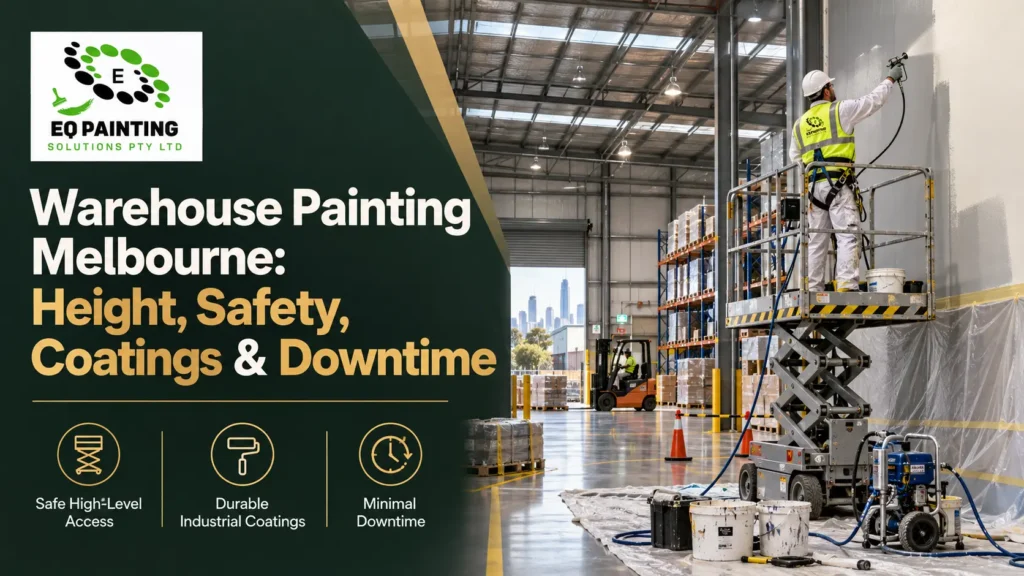
Painting a warehouse has almost nothing in common with painting a house. The paint is the easy part. The real job is getting a crew safely up to a ten-metre ceiling, coating structural steel and huge wall areas without shutting the building down, and doing it all in line with Victorian workplace health and safety requirements while your forklifts and dispatch keep moving underneath. Warehouse painting in Melbourne is a logistics and safety exercise as much as a painting one.
This guide walks through what actually matters when you’re planning a warehouse painting project: why height and access drive everything, the safety and compliance side, how a good crew keeps your operation running while they work, which coatings suit warehouse walls, ceilings and steel, and what really moves the price. If you’d rather go straight to a quote, we handle commercial and warehouse painting across Melbourne.
Why Warehouse Painting Is a Different Job
Three things set a warehouse apart from almost any other paint job. First, scale and height — you’re dealing with thousands of square metres of wall and ceiling, often 8–12 metres up, which means elevated work platforms (scissor lifts, boom lifts) rather than a ladder and a drop sheet. Second, the building can’t stop — most warehouses run dispatch, receiving and forklift traffic all day, so the work has to be staged around live operations or scheduled after hours. Third, the surfaces are industrial — precast concrete panels, Colorbond and metal cladding, exposed structural steel, and high-bay ceilings, each needing a different coating approach than interior plasterboard.
Working at Height: Access and Safety
Access is usually the single biggest factor in a warehouse job — more than the paint, sometimes more than the wall area. Reaching a high-bay ceiling or the top of a 10-metre wall safely means the right elevated work platform for the space, trained operators, and a plan for working around racking, stock and moving equipment below.
In Victoria, industrial painting at height must be carried out in line with Victorian workplace health and safety requirements set by WorkSafe — including working-at-height controls, correct EWP operation, and site-specific safety documentation (a SWMS). A proper warehouse painter carries current public liability insurance and works to those standards rather than improvising with ladders. It’s worth confirming any contractor can produce their insurance and safety paperwork before they set foot on site — on an operating warehouse, that’s not red tape, it’s what keeps your staff and theirs safe.
Keeping Your Warehouse Running
A warehouse can’t halt dispatch while walls dry. The way a good crew handles that is staging: sectioning the building so painting happens in one zone while the rest keeps operating, working after hours or on weekends where needed, and using low-odour coatings so staff aren’t working in fumes. As a general guide, a small single-zone repaint may take a few days, while a large facility with high-bay ceilings, structural steel and staged after-hours access can run to several weeks — the exact timeline depends on the scope and how much of the building needs to stay open at once. The scheduling conversation — which zones, which hours, how much can be closed off at once — usually matters more to the final cost and disruption than the colour does. It’s the same logistics-first thinking behind office painting, scaled up.
Best Coatings for Warehouse Walls, Ceilings and Steel
Different warehouse surfaces need different systems. Walls (precast concrete, blockwork, metal cladding) generally take a durable, washable commercial acrylic that stands up to knocks, dust and cleaning. Ceilings and high-bay areas are often sprayed for speed and even coverage across large areas — spraying at that scale needs careful masking and protection of racking and stock, proper ventilation, isolating the work zone from the rest of the floor, and is frequently scheduled after hours to avoid overspray and fumes affecting staff. Structural steel is its own category — where corrosion is a risk, a protective anti-corrosive system matters, and where fire ratings are required, intumescent (fire-rated) coatings are a certified specialist product, not a standard paint. The right system depends on the surface, the environment inside the building, and what the space is used for, so it’s matched per project rather than a one-size spec.
Warehouse floors are a separate trade again — usually an epoxy or resin coating with line marking, not wall paint. We cover that under commercial epoxy flooring.
Why Repaint a Warehouse?
Beyond appearance, a fresh coating protects the building — sealing concrete and guarding exposed steel against corrosion. Lighter walls and ceilings improve visibility and can make a space feel cleaner and less worn, which matters for staff working in it every day and for any client, supplier or auditor who visits the site. Refreshed line marking alongside a repaint helps keep traffic routes, storage zones and safety areas clearly organised. None of that shows up on a balance sheet immediately, but a well-maintained facility is generally cheaper to keep that way than one left to degrade to the point of major repair.
What Does Warehouse Painting Cost in Melbourne?
There’s no flat rate for warehouse painting, because the variables swamp the paint cost. What drives the price: the wall and ceiling area, the height and how it’s accessed (EWP hire is a real line item), the surfaces involved (plain walls are cheaper than structural steel or fire-rated systems), how much prep and repair the surfaces need, whether the coating is a standard commercial acrylic or a specialist protective system, and whether the work runs during business hours or after hours.
As a rough sense of the spread: a straightforward single-zone wall repaint sits at the lower end, while a full building with high-bay ceilings, structural steel and after-hours staging sits well above it. Because of that range, an accurate figure only comes from a site walkthrough. We inspect the building with you or your facilities manager, agree the scope zone by zone, and provide a detailed written quote based on that agreed scope. For how commercial pricing works more broadly, see our commercial painting cost Melbourne guide.
Related Articles
Frequently Asked Questions About Warehouse Painting in Melbourne
Preparation depends on the surface, but on most warehouses it starts with cleaning — pressure washing or degreasing walls and steel to remove dust, oil, and grime so coatings can bond. Any rust on structural steel is treated back to sound metal, flaking or failed coatings are removed, and cracks or damage in concrete panels are repaired. Bare or porous surfaces are primed with the right primer for that substrate. Just as important is the site prep: masking and protecting racking, stock and equipment, and planning access and staging so the work happens safely around live operations. Skipping surface prep is the main reason an industrial coating fails early.
By staging the work. The building is sectioned into zones so painting happens in one area while dispatch, receiving and forklift traffic keep running elsewhere. Where a zone can't be closed during trading, the work shifts to after hours or weekends. Low-odour, fast-drying coatings help keep staff comfortable and areas back in use sooner. The scheduling plan — which zones, which hours, how much can be closed off at once — is agreed up front so the repaint fits around your operation rather than stopping it.
For warehouse walls — precast concrete, blockwork or metal cladding — a durable, washable commercial acrylic is the usual choice, because it stands up to knocks, dust and cleaning. High-bay ceilings are often sprayed for speed and even coverage over large areas. Structural steel is different again: where corrosion is a risk it needs a protective anti-corrosive system, and where fire ratings apply, intumescent coatings are a certified specialist product rather than standard paint. The right system is matched to each surface and to how the building is used, not applied as a single spec across everything.
With the right elevated work platform for the space — scissor lifts for open floors, boom lifts to reach over racking, and other access equipment as the layout requires — operated by trained crew. In Victoria this work falls under WorkSafe and Australian OH&S requirements, including working-at-height controls and site-specific safety documentation (a SWMS). Reaching high-bay areas isn't a ladder job; it needs proper equipment, trained operators and a plan for working around stock and moving forklifts below. Access is often the single biggest factor in both the safety plan and the cost of a warehouse job.
Industrial and warehouse painting in Victoria is governed by WorkSafe Victoria and Australian OH&S/work health and safety standards. In practice that means working-at-height controls, correct use of elevated work platforms, and a Safe Work Method Statement (SWMS) for the site, along with appropriate handling of coatings and ventilation. A professional warehouse painter also carries current public liability insurance suited to commercial sites. Before work starts it's reasonable to ask a contractor to produce their insurance and safety documentation — on an operating warehouse that paperwork is what protects your staff and theirs.
It depends on the size of the building, the surfaces involved, the access required and whether the work runs during business hours or after hours. A single-zone wall repaint can be a few days; a full building with high-bay ceilings, structural steel and after-hours staging runs considerably longer. Staging around live operations also stretches the calendar, because only part of the building is worked at a time. The realistic way to get a timeline is a site walkthrough — once the scope and access are clear, the schedule can be planned zone by zone.
They can be coordinated, but they're a different trade. Warehouse floors are usually finished with an epoxy or resin coating and line marking rather than wall paint, because they have to take forklift traffic, point loads and chemical spills. Walls and ceilings are a decorative and protective coating job; floors are a specialist flooring job. Many warehouse contracts bundle both together and sequence them so the floor coating and line marking go down at the right stage. We cover the floor side under commercial epoxy flooring.
Beyond appearance, a fresh coating protects the building fabric — sealing concrete, guarding steel against corrosion, and extending the life of walls and cladding. A brighter interior improves visibility and can lift how safe and productive the space feels to work in, and refreshed line marking and colour coding support safety and workflow. For businesses that host clients, suppliers or auditors on site, a well-maintained warehouse also presents better. Regular maintenance repaints are cheaper over time than letting surfaces degrade to the point of major repair.
There's no flat rate, because access and surfaces drive the price more than paint does. Cost depends on the wall and ceiling area, the height and how it's reached (elevated work platform hire is a real line item), the surfaces involved (plain walls are cheaper than structural steel or fire-rated systems), the amount of prep and repair, the coating system chosen, and whether work runs in business hours or after hours. A straightforward single-zone repaint sits at the lower end; a full high-bay building with steel and after-hours staging sits well above it. An accurate figure comes from a site walkthrough and a fixed written quote, not a per-metre guess.
Get Your Warehouse Painted Without the Downtime
A warehouse repaint done properly protects your building, keeps your team safe, and works around your operation instead of stopping it. Whether it’s tired precast walls, high-bay ceilings, structural steel needing protection, or a full facility refresh with line marking, the job comes down to the right access, the right coatings, and a schedule built around your dispatch. EQ Painting Solutions has been handling commercial and industrial painting across Melbourne since 2011 — fully insured, safety-compliant, and set up to stage work around live sites.
For a detailed written quote based on a walkthrough of your building, call us on 0498 200 654 or request a free quote online.