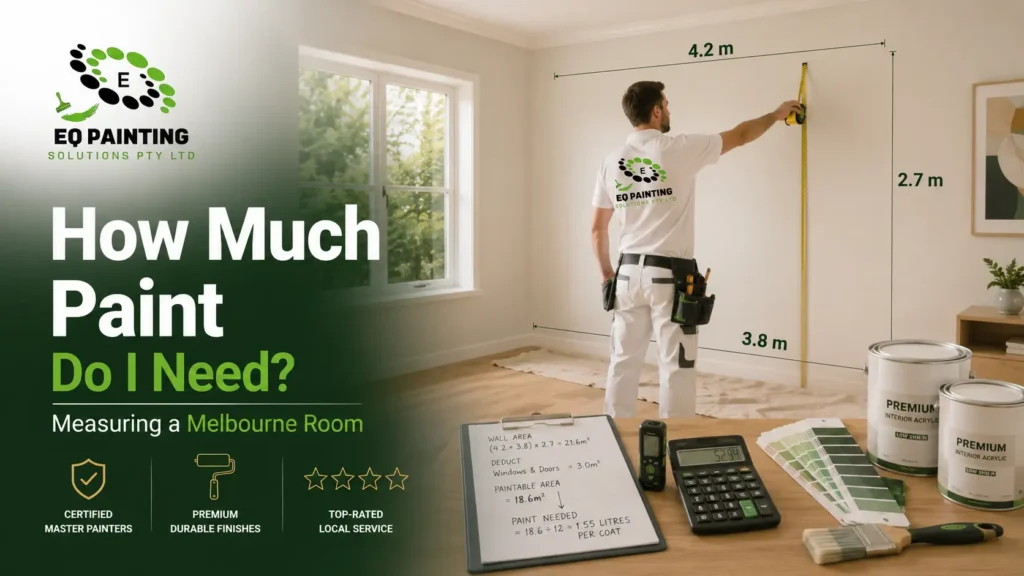
The quick answer: take your total wall area, subtract the doors and windows, then divide by the paint’s coverage rate — around 16m² per litre for most interior walls — and multiply by the number of coats. For a standard Melbourne bedroom that usually lands between 4 and 6 litres for two coats. But the honest version is that how much paint you need depends heavily on what you’re painting over, and that’s where most DIY estimates go wrong. This guide gives you the formula, a real worked example in metres, the coverage rates that actually apply here, and the mistakes that leave you halfway up a wall with an empty tin. If you’d rather skip the maths and get a fixed price, our guide to accurate painting quotes in Melbourne covers that side.
The Formula That Does the Job
Every paint calculator online is running the same simple sum. You can do it on the back of an envelope:
Paintable area ÷ coverage rate × number of coats = litres needed.
To get your paintable area, measure the length and height of each wall, multiply them, and add the walls together. Then subtract the openings — a standard door is roughly 1.8m² and an average window about 1.4m². Don’t paint those, so don’t pay for them. The coverage rate is printed on the back of the tin (look for “spread rate”), and two coats is the standard for a proper finish.
A Real Melbourne Example
Say you’re repainting a bedroom that’s 4m by 3.5m, with the standard 2.4m ceiling height most Melbourne homes have.
- Wall perimeter: (4 + 3.5) × 2 = 15m
- Wall area: 15 × 2.4 = 36m²
- Subtract one door (1.8m²) and one window (1.4m²): about 33m²
- Two coats: 33 × 2 = 66m² of coverage needed
- At 16m² per litre: 66 ÷ 16 = around 4.1 litres
So you’d buy a 4L tin plus a 1L, giving you a comfortable margin. If those walls are bare or patchy plaster rather than a sound painted surface, drop your coverage estimate to about 12m²/L and the same room jumps to roughly 5.5 litres. That single assumption — sealed wall versus thirsty plaster — is the difference between one trip to the shop and two.
How Far a Litre Actually Goes
Coverage isn’t one number. It changes with the surface and the product. Here’s the realistic range for Australian paints:
| Surface / product | Rough coverage per litre |
|---|---|
| Interior walls (premium, sealed surface) | up to 16m² |
| Interior walls (budget or porous) | around 12m² |
| Ceilings | about 12–14m² |
| Primer / undercoat | about 12–14m² |
| Exterior walls | about 8–10m² |
| Trim, doors and woodwork | about 7–10m² |
Premium paints like Dulux Wash&Wear and Taubmans sit at the top of the interior range because they have higher solids content. Cheaper trade tins cover less and often need an extra coat, which quietly wipes out the saving. It’s worth reading our take on the best paint brands in Australia before you buy on price alone.
What Quietly Throws the Numbers Off
The formula is easy. The estimate goes wrong because of what’s under the roller. The main culprits we see on site:
- Porosity. Bare plaster, render and fresh patching soak up the first coat and slash your coverage. Seal it first.
- Colour change. Going dark to light — or covering a strong feature wall — can need three coats, or a tinted undercoat to save one.
- Texture. Rough render, brick and profiled surfaces have far more surface area than a flat wall, so they drink more paint.
- Forgotten surfaces. Ceilings, skirting, architraves, doors and window frames all need paint and are easy to leave out of the sum.
If your walls are anything other than a smooth, previously painted surface in good nick, add a margin. And if the job’s a whole house or a big colour change, it’s often quicker and cheaper to have a painter measure it properly — a rough estimate on a large exterior can be litres out. We’re happy to take a look and give you a straight figure.
Always Buy a Little Extra
Here’s the one rule every painter follows: buy slightly more than the calculation says, never less. We add around 10–15% on top. Running out mid-wall means a second trip, and worse, a fresh tin from a different batch can be a shade off — noticeable across one continuous wall. A bit of leftover paint is also your touch-up kit for scuffs down the track. Write the colour name and batch number on the lid so you can match it later, and if you want the cost side mapped out too, our house painting cost guide for Melbourne breaks down what the whole job runs to.
Related Articles
More from our Melbourne painting team:
Frequently Asked Questions
Measure each wall (length × height), add them up, and subtract doors and windows. Divide that paintable area by your paint's coverage rate — around 16m² per litre for most interior walls — then multiply by the number of coats. That gives the litres you need.
Two coats is standard for a quality, even finish on previously painted walls in good condition. A big colour change — especially dark to light — or bare plaster usually needs a primer coat plus two topcoats. A same-colour refresh on a sound surface can sometimes get away with one.
Surface porosity is the biggest one — bare or patchy plaster drinks paint. Colour change, texture, sheen level and paint quality all matter too. A premium paint might cover 16m²/L while a budget tin manages 12m²/L on the same wall. Always check the tin's spread rate.
Slightly more, every time. Running out mid-job means a second trip and the risk of a different batch that doesn't quite match. We buy around 10–15% over the calculated amount. Leftover paint is also handy for touch-ups — just note the colour and batch number.
As a rough guide, a standard 3-bedroom Melbourne home takes around 60–80 litres for the full exterior in two coats. Exterior paint covers less than interior — about 8–10m² per litre — and porous brick or render pushes that lower. Measure the walls for an accurate figure.
Trim and woodwork use less paint but cover slower — roughly 7–10m² per litre. For a standard door, allow around 0.5 litres for two coats per side. Frames and skirting add up, so measure their length and rough width rather than guessing.
Measure the wall area, subtract the door, window and any tiled sections you're not painting, then divide by the coverage rate and multiply by two coats. A small bathroom often needs only 1–2 litres, so a 1L or 2L tin of a moisture-resistant paint usually covers it.
A standard single garage door is roughly 5–6m². At two coats and around 12m²/L for exterior enamel, that's under 1.5 litres — a 1L or 2L tin usually does it. A double door roughly doubles that. Rough or profiled doors use a little more.
For a single room, feature wall or trim, a 1L, 2L or 4L tin is usually the sweet spot. Whole rooms or several spaces are cheaper per litre in a 10L or 15L. Buy the size that matches your calculated litres plus a small margin, not a huge tin you'll barely open.
How Much Does 1 Litre of Paint Cover?
As a rule of thumb, 1 litre of interior wall paint covers roughly 10 to 16m² per coat on a smooth, sealed surface — most premium acrylics quote around 16m²/L. So a standard 4-litre tin covers about 40 to 64m² per coat, and you’ll usually get two coats out of it on a small-to-medium room. Real-world 1L paint coverage drops on porous, patchy or freshly plastered walls (they drink the first coat), on rough or textured surfaces, and when you’re making a big colour change that needs an extra coat. Always check the spread rate printed on your specific tin and add a 10% margin.
Working out how much paint you need isn’t complicated — measure the area, subtract the openings, check the spread rate on the tin, and multiply by two coats. The part that catches people out is the surface underneath: porous plaster, a big colour change or textured walls all pull your coverage down, so build in a margin and always buy a little extra rather than a little less.
If you’d rather not measure and second-guess it — especially on a whole house or exterior where being litres out gets expensive — we’re happy to measure up and give you a clear quote. Get in touch for a free quote — free quotes across Melbourne. Call us on 0498 200 654.
Pingback: Spray Painting vs Roller: Which Is Better? | Melbourne Painter