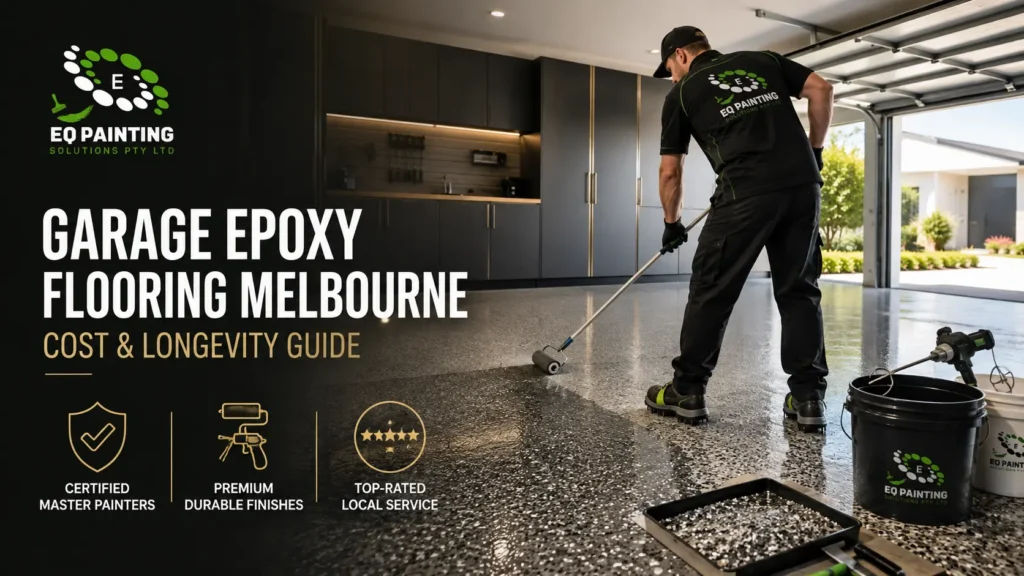
A garage floor takes a different kind of beating than the rest of the house. Car tyres drag in grit off the driveway, oil drips sit for weeks before anyone notices, and in a lot of Melbourne homes the garage doubles as a workshop with dropped tools and the odd spilt tin of degreaser. Garage epoxy flooring in Melbourne — or epoxy flooring garage installation, as some homeowners search it — holds up to that in a way bare concrete or a painted floor never does, but only if it’s put down properly. If you’re weighing it up against our broader epoxy flooring services, here’s what actually matters for a garage specifically — cost, lifespan, and the prep steps that separate a floor that lasts from one that lifts at the edges within a year.
What Changes When It’s a Garage, Not a House Floor
Living-area epoxy mostly deals with foot traffic and the odd dropped plate. A garage floor deals with point loads from a car parked in the same two spots every day, hot tyres that can soften and drag a poorly cured coating, and chemical exposure from brake fluid, fuel, and coolant that a general-purpose coating won’t shrug off. That’s why we always spec a two-pack epoxy system for garages — the same water-based coatings that work fine in a laundry or hallway don’t hold up under a car.
What Affects the Price
For a straightforward garage floor, expect to sit within the same $45–$120 per square metre installed range we quote across all our epoxy work — the detail is at the bottom end for a single garage in reasonable condition, climbing toward the top end when there’s more prep involved. A single garage in Melbourne is typically 18–20m², so most jobs land as a fixed quote rather than a big spend. A few things push it up: existing oil staining that needs degreasing and etching before the epoxy will bond, a slab with cracks or previous coating that needs grinding back to bare concrete, or a request for a heavier-duty flake or quartz broadcast finish instead of a flat colour. We break down the full cost picture, including what changes the quote, in our epoxy flooring cost guide.
How Much Does a Garage Floor Coating Cost?
People search this a dozen different ways — garage epoxy floor cost, garage floor coating cost, garage floor paint cost, garage epoxy price, epoxy flooring garage cost, how much do epoxy garage floors cost — so here it is as real total figures, not just a per-metre rate. At our installed rate of $45–$120/m², here’s roughly what a finished garage floor costs by size in Melbourne:
| Garage size | Approx. area | Typical installed cost |
|---|---|---|
| Single garage | 18–20 m² | $1,200 – $2,400 |
| Double garage | 36–40 m² | $2,200 – $4,500 |
| Triple garage | 54–60 m² | $3,200 – $6,500 |
The double garage epoxy cost is the one we’re asked about most, and it usually lands between $2,200 and $4,500 depending on slab condition and finish. A plain flat-colour coating on a sound, clean slab sits at the lower end; oil-stained or cracked concrete that needs grinding and repair, or a flake or quartz broadcast finish, pushes toward the top. A simple roll-on garage floor paint costs less up front but rarely lasts under a car, which is why we quote a two-pack epoxy system rather than a paint-on coating.
How Long a Garage Epoxy Floor Actually Holds Up
Done properly — grinding the slab, priming, then two coats of two-pack epoxy — a garage floor holds up well for 8–10 years of daily car use before it needs a refresh coat, longer in a garage that’s mainly used for storage. It won’t last forever, and we’re not going to tell you it will. The most common failure we see isn’t the epoxy wearing through; it’s peeling at the edges near the roller door, usually because the floor wasn’t ground back properly before coating or moisture was still coming up through the slab. UV yellowing is the other real-world issue — a garage that gets direct sun through an open roller door for hours a day will yellow a light-coloured floor faster than one that stays shut, which is worth factoring into your colour choice.
Colour and Finish Choices That Make Sense for a Garage
Darker greys and charcoals hide tyre marks, dust, and the odd oil spot far better than white or pale grey — something we always mention when a customer’s set on a bright showroom look. A non-slip additive broadcast into the final coat is worth adding if the garage gets wet from cars parked straight off a rainy driveway; it costs a little more but matters more in a garage than almost anywhere else in the house. We’ve put together a full breakdown of colour options in our epoxy floor colours guide if you want to see what’s held up well in other Melbourne garages.
If you’re at the quote stage and want a fixed price before committing, our team can walk the garage, check the slab condition, and give you a number on the spot — book a quote here and we’ll tell you honestly if the floor needs extra prep before we coat it.
Prep Steps We Actually Do Before Coating
This is where most of the difference between a good and bad epoxy job happens, and it’s invisible once the floor’s finished:
- Moisture test the slab — coating over a damp garage floor is the number one cause of early peeling
- Diamond grind the surface to open the concrete pores so the epoxy actually bonds, rather than sitting on top
- Fill cracks and any pitting with an epoxy-compatible filler before priming
- Degrease and etch any existing oil-stained patches so the primer doesn’t fail in those spots
- Apply primer, then two coats of two-pack epoxy with the appropriate recoat window between coats
A full cure typically takes 5–7 days before we recommend parking a car on it, even though the floor is walkable within 24 hours.
Epoxy vs Polished Concrete for a Garage
We get asked about this a lot, especially from customers weighing up a garage against a broader concrete resurfacing job. Epoxy wins on chemical and stain resistance, which matters more in a garage than a living space — polished concrete looks great but shows oil and brake fluid stains more readily. We’ve written a full side-by-side comparison in Epoxy Flooring vs Polished Concrete if that’s still an open question for your space.
Related reading:
Frequently Asked Questions
A two-pack epoxy system with a broadcast non-slip additive is the best option for most Australian garages, since it resists oil, brake fluid and tyre marks far better than single-pack paint-on coatings. The result only lasts if the slab is diamond-ground and moisture-tested first — skipping that prep is the main reason cheaper epoxy jobs peel within a year.
A double garage (around 36–40m²) typically costs $2,200 to $4,500 installed in Melbourne. The lower end is a flat-colour coating on a clean, sound slab; the upper end reflects grinding, crack repair or a flake or quartz finish.
A roll-on garage floor paint is cheaper up front, but single-pack paints don't hold up to hot tyres, oil and the point loads from a parked car, so they usually peel or wear within a year or two. A two-pack epoxy system costs more but lasts 8–10 years, which works out cheaper over time.
A garage floor is one of the few surfaces in the house that’s genuinely worth getting quoted properly rather than guessing. If you’re in Melbourne and want an honest look at your slab before committing to a colour or finish, we’re happy to come out and check it — call us on 0498 200 654 or request a free quote and we’ll tell you straight whether your garage needs extra prep or not.
Pingback: Epoxy Flooring Maintenance Melbourne: Keep It Looking New
Pingback: Painting Concrete Floors: Best Coatings, Prep & Primers