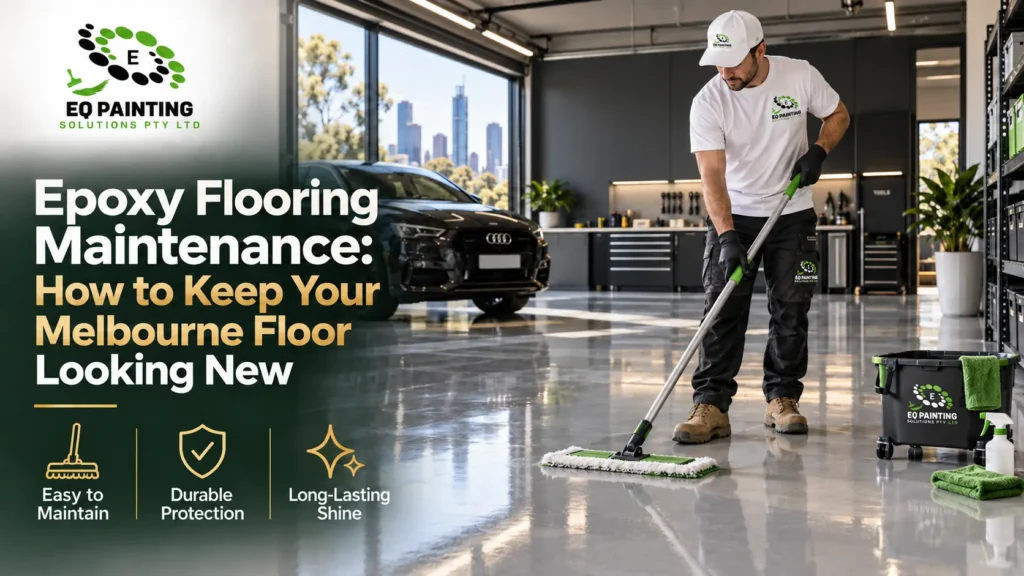
Most epoxy floor maintenance advice you’ll find online was written for garages in Minnesota or Michigan — places where cars drag in road salt every winter and the real enemy is freeze-thaw cracking. Melbourne garages have almost none of those problems. What they do have is fierce summer UV through an open roller door, fine grit blown in off dry driveways, and the odd oil drip from a car that lives on the same two spots year-round. Look after those three things and a properly installed epoxy floor can hold its finish for many years — often around 8–10 years in a well-installed residential garage when it’s properly maintained.
Epoxy Floor Maintenance at a Glance
If you only remember one thing, make it this table — it covers almost everything a Melbourne garage floor will ever need:
| Issue | What to do |
|---|---|
| Dust & grit | Soft dry sweep or dust-mop, weekly |
| General grime | Warm water with a pH-neutral cleaner |
| Oil or coolant spills | Wipe immediately; concrete degreaser if needed |
| Tyre marks | Concrete degreaser + stiff nylon brush |
| Lost gloss / fading | Professional inspection or a clear recoat |
How Often Should You Clean an Epoxy Floor?
The honest answer is less often than most guides suggest, because dirt doesn’t bond to a sealed epoxy surface the way it does to bare concrete. A realistic Melbourne routine looks like this:
- Weekly: a dry dust-mop or soft broom to lift grit before it gets ground in underfoot or under tyres. Grit is the single biggest cause of a dull, scratched floor.
- Monthly: a light mop with warm water and a pH-neutral cleaner to lift general grime and bring the gloss back.
- As it happens: wipe spills — oil, coolant, brake fluid — as soon as you notice them. Nothing sits and stains on epoxy the way it does on raw concrete, but the sooner it’s gone, the less chance of a mark.
A single-car home garage that’s mostly used for storage might genuinely only need a proper mop every couple of months. A working garage or one that doubles as a workshop needs the weekly sweep more than anything else.
What to Clean an Epoxy Floor With (and What to Never Use)
The golden rule: pH-neutral only. Epoxy is chemically tough, but the wrong cleaner will either strip the gloss or leave a film that dulls it.
Safe to use
- Warm water on its own for a quick clean
- A pH-neutral floor cleaner diluted per the label
- A microfibre or soft-foam mop, or a soft-bristle broom
- A concrete degreaser for oil and tyre marks (spot use only)
Best avoided
- Vinegar or any acidic cleaner — repeated use can slowly etch and deglos the surface
- Strong ammonia-based, citrus-based or solvent-heavy cleaners — avoid these unless the flooring manufacturer specifically approves them, as repeated use may dull the finish or leave a residue
- Abrasive pads, steel wool, or a stiff wire brush — they scratch the topcoat permanently
- A mechanical buffer or scrubber — buffing an epoxy coat deglosses it rather than shining it, which surprises a lot of people
If you’re ever unsure, plain warm water and a microfibre mop will clean 90% of what a home garage floor ever needs.
Removing Tyre Marks From an Epoxy Garage Floor
Tyre marks are the number-one thing Melbourne owners ask us about. They’re not damage — they’re a residue transfer from hot tyres, and they lift with the right approach:
- Saturate the marks with a concrete degreaser and let it sit for around 10 minutes.
- Scrub with a stiff nylon (not wire) brush.
- Rinse with warm water and wipe dry. Repeat once if any shadow remains.
To prevent them coming back on a car that sits in the same spot daily, a small rubber mat or park-mat under the tyres solves it entirely. Darker floor colours also hide the occasional mark far better than a pale grey or white — something worth knowing before you pick a colour, which we cover in our epoxy floor colours guide.
How to Restore Shine to a Dull Epoxy Floor
If your floor has gone dull, first work out why — because the fix depends on the cause. A film from the wrong cleaner mops off with warm water and a pH-neutral cleaner. Fine surface scratches from grit are the more common culprit in Melbourne garages, and those don’t buff out. When the gloss is genuinely worn rather than just dirty, the answer isn’t a product off a shelf — it’s a fresh clear topcoat over the existing floor. A recoat is a fraction of the cost and disruption of a full re-do, since the hard prep work was done the first time around.
When to Reseal or Recoat Epoxy Flooring
A well-installed residential epoxy floor generally holds its finish for 8–10 years before it needs a refresh clear coat, and often longer in a low-use garage — though the exact lifespan depends on the coating system, film thickness, prep, sun exposure and how much traffic the floor sees. You’re not resealing on a fixed schedule — you recoat when the signs appear:
- The gloss has dulled evenly across the high-traffic path even after a proper clean
- Fine scratching is visible across the tyre tracks or the walkway
- The colour has faded where direct sun hits it daily
That last one — UV fade — is the Melbourne-specific issue. A garage with the roller door open for hours in summer will fade a light floor faster than a closed one, especially near the door opening. If UV is a concern, a UV-stable topcoat such as a polyurethane or polyaspartic clear coat holds colour far better than standard epoxy at recoat time. This is very different from a floor that’s peeling or bubbling, which is a bonding or moisture failure, not a maintenance issue.
Commercial and High-Traffic Epoxy Floor Maintenance
A warehouse, workshop, or showroom floor takes a different level of wear — forklift wheels, pallet drags, and foot traffic all day. The principles are the same but the frequency scales up: daily sweeping to keep grit off, weekly mopping with a pH-neutral cleaner, and a professional inspection once a year to catch worn patches before they reach the concrete. Depending on traffic, equipment and coating wear, some commercial floors also benefit from scheduled maintenance recoats in their highest-traffic zones — far cheaper than letting the coating wear through and having to grind and re-lay. One safety note that matters more in a commercial setting: an epoxy floor is slippery when wet, so any cleaner should be rinsed off thoroughly and wet areas flagged until dry. If you run a commercial space, our commercial epoxy flooring page covers the heavier-duty systems built for that load.
DIY vs Professional Epoxy Maintenance
Day-to-day care is entirely DIY — sweeping, mopping, spot-cleaning spills and tyre marks needs nothing more than a mop, a pH-neutral cleaner, and a degreaser. Where a professional earns their keep is the recoat: getting a clear topcoat to bond properly means the existing floor has to be cleaned and lightly abraded correctly first, and a badly prepped recoat peels within months. So the rule of thumb is simple — clean it yourself, but bring in a professional the moment the floor needs a fresh coat rather than just a wash.
Related Articles
If you’re caring for or planning an epoxy floor, these guides go further:
- Epoxy Flooring Melbourne — our full epoxy flooring service and finishes
- Garage Epoxy Flooring Melbourne — costs, lifespan and prep
- How Much Does Epoxy Flooring Cost in Melbourne?
- Epoxy Flooring vs Polished Concrete
Frequently Asked Questions
Keeping Your Epoxy Floor Looking New, Long Term
Epoxy is one of the lowest-maintenance floors you can own — the trick is doing the small things (sweep the grit, wipe the spills, skip the harsh cleaners) and knowing when a floor needs a professional recoat rather than another wash. Get that balance right and a Melbourne garage floor will stay glossy and hard-wearing for well over a decade.
If your epoxy floor is looking tired, dull, or worn through in the traffic path, EQ Painting Solutions can assess whether it needs a clean, a recoat, or a full re-lay — and tell you honestly which. Free assessments across Melbourne — call 0498 200 654.