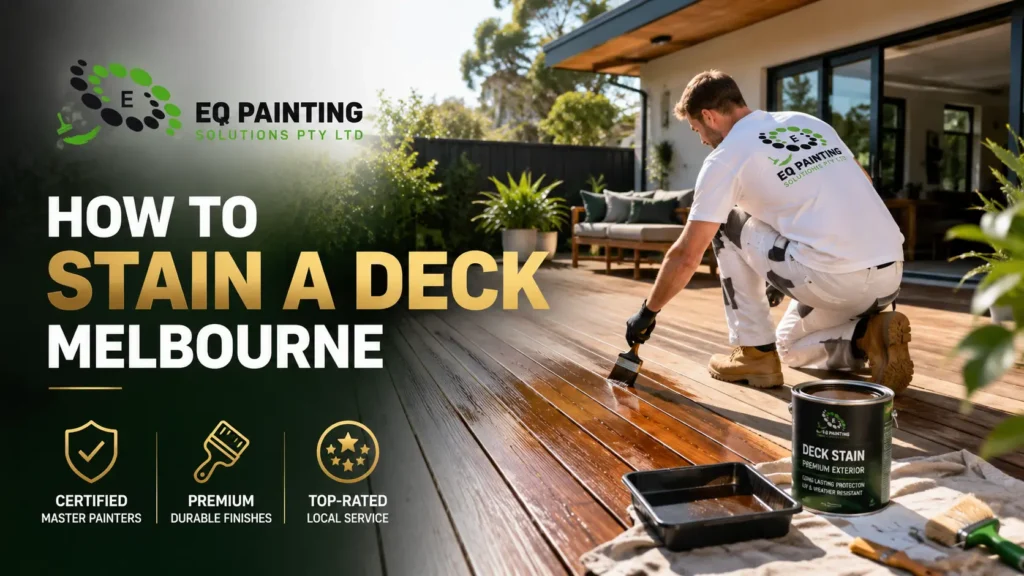
The call we get most often about decks comes in around September. Someone oiled their merbau deck in the middle of a Melbourne winter, it never properly dried, and now it’s blotchy, still slightly tacky underfoot, and lifting in the shaded corner. The product wasn’t the problem and neither was the technique. Knowing how to stain a deck properly is mostly about knowing when the timber is ready, and Melbourne timber spends about five months of the year not being ready.
Deck work is unforgiving in a way wall painting isn’t. A deck sits flat, so water pools on it instead of running off. People walk on it. It cops direct summer UV all day and then sits damp for weeks in July. Very few finishes survive that if the prep was rushed.
This guide covers what we actually check before a brush touches the timber: whether staining or painting is the right call, the merbau problem almost nobody warns you about, how to read the weather window, and the order that gives you an even finish. If your whole exterior is due, our exterior house painters in Melbourne page covers the broader job.
How to Stain a Deck: The Short Answer
Clean the deck thoroughly, strip any old coating, let the timber dry to below roughly 16% moisture, then apply decking oil or stain thinly along full boards end to end, keeping a wet edge. Two thin coats outperform one heavy coat, which stays tacky and traps dirt.
Everything below is the detail that decides whether that actually works or not.
Should You Stain or Paint a Deck?
For a timber deck, stain or decking oil is almost always the better choice. Paint forms a film that sits on top of the boards, and on a horizontal surface that gets walked on, pools water and moves with the seasons, that film eventually lifts. Once it starts peeling, your only options are a full strip or living with it.
Stains and oils penetrate instead of coating. When they wear, they wear thin and even, which means a clean and a recoat rather than a strip.
| Decking oil / stain | Deck paint | |
|---|---|---|
| How it fails | Fades and thins gradually | Peels and flakes in patches |
| Recoating | Clean and reapply | Usually needs a full strip |
| Grain visible | Yes | No |
| Best suited to | Hardwood and treated pine decks | Already-painted decks, or covered verandah boards |
The main exception is a deck that has already been painted. Stripping film-forming paint off decking is slow, expensive work, and repainting is sometimes the more sensible call. Which brings us to the specific issue that catches out most Melbourne homeowners.
The Merbau Problem Nobody Warns You About
Most decks around Melbourne are merbau, and merbau leaches tannin. On a new or freshly cleaned deck, the first decent rain pulls a dark reddish-brown run-off out of the timber that stains pale concrete, render, pavers and light-coloured brick around the deck edges.
What that means in practice:
- Wash new merbau down before you coat it. Hose it repeatedly over a few weeks and let the tannin run out while you can still rinse the surrounds.
- Protect what’s below and around. Pale paving next to a merbau deck is the thing people regret not covering.
- Don’t oil brand new merbau immediately. New boards carry mill glaze and their own oils, and coatings sit on the surface rather than soaking in. Weathering it for several weeks first gives far better penetration.
- Use a proper deck prep or cleaner on greyed timber. Oxalic-acid based deck cleaners bring the colour back and open the grain. Plain water won’t.
Treated pine behaves differently again, with less tannin but more movement. Either way, the timber has to be dry before anything goes on it, and that’s where Melbourne makes life difficult.
The Best Weather Conditions and Season for Staining an Outdoor Deck
Stain a deck when the timber is dry, the temperature sits between roughly 10°C and 30°C, and no rain or heavy dew is due for 24 to 48 hours. In Melbourne that realistically means October through April, and the shoulder months are safer than the peak of summer.
Two things ruin more deck jobs here than any product choice.
Winter moisture. A deck that looks dry on top can still be sitting at high moisture content underneath, particularly on the shaded south side. Stain can’t penetrate wet timber, so it sits on the surface, stays tacky and eventually lifts. If you can, allow a few consecutive dry days before you start rather than one dry morning.
Autumn dew. This one surprises people. You can finish a coat at 4pm on a beautiful April afternoon and still ruin it, because heavy overnight dew settles on a finish that hasn’t cured. Finish early enough in the day that the coating is properly touch-dry before the temperature drops.
Mid-summer has the opposite issue. A deck in full sun at 35°C will flash-dry the oil before it soaks in, leaving lap marks where wet and dry edges met. Work in the shade, follow the sun around, or start early.
If you’d rather not gamble a weekend on the forecast, we book deck work into the right window as a matter of course. You’re welcome to get a free quote and we’ll tell you honestly whether your deck is ready or needs another month.
The Right Order to Tackle the Job
Sequence matters more than speed here. This is the order we work in:
- Check the boards. Punch down any proud nails or screws, replace anything soft or split. Coating over rot just hides it.
- Strip or clean. Old film-forming coatings need a stripper. Greyed or previously oiled timber needs a deck cleaner or prep, scrubbed with a stiff broom along the grain.
- Rinse thoroughly. Cleaner residue left in the timber interferes with the coating. Take the pressure washer down or skip it, since high pressure furs up the grain badly on softer boards.
- Let it dry. Two to three dry days is a reasonable minimum. A cheap moisture meter is worth more than most of the tools people buy for this job.
- Sand if needed. Light sanding knocks back raised grain and evens out stripper marks. Not always necessary on a well-maintained deck.
- Cut in the edges, then coat full boards. Always work a whole board end to end without stopping mid-run. This is the single biggest cause of visible lap marks.
- Two thin coats. Follow the recoat time on the tin. Water-based decking products are often recoatable in a few hours, oil-based typically want overnight.
- Wipe back any excess. If the timber won’t absorb it, it won’t cure. Pooled product stays sticky and picks up dirt for months.
Australian products worth knowing: Cabot’s Aquadeck and Natural Decking Oil, Intergrain UltraDeck, and Feast Watson decking ranges all perform well when applied to properly prepared timber. The brand matters far less than the prep underneath it.
Choosing the Right Deck Stain: Types and Best Products
“Deck stain” actually covers a few different products, and picking the right type matters as much as the colour. There are three broad kinds, from most to least grain visible:
- Transparent and natural deck stains (decking oils). These penetrate the timber and show the grain fully. They give the most natural look, are the easiest to recoat, and are what we use on most merbau and hardwood decks.
- Semi-transparent deck stains. A touch more pigment for colour and UV protection while still letting the grain show through. A good middle ground on decks that get a lot of sun.
- Solid or full-bodied deck stains. Closer to a paint, with an opaque finish that hides grain and worn timber. More UV protection, but they wear more like a film on a walked-on surface, so we generally reserve them for older or previously coated decks.
People also search for a “wood stain” for a deck — but on an outdoor deck you want a purpose-made decking stain or oil, not a general interior wood stain, because deck products are built to flex, shed water and resist UV underfoot. For the oil-based versus water-based question, see the FAQ below; in short, prep matters far more than the base.
Best deck stains in Australia: Cabot’s Aquadeck and Natural Decking Oil, Intergrain UltraDeck and Nature’s Timber Oil, Feast Watson decking ranges, and Sikkens for a premium finish all perform well on properly prepared timber. As always, the brand matters far less than the moisture level and prep underneath it.
How Long the Finish Actually Lasts
On a fully exposed Melbourne deck, expect to recoat decking oil somewhere between every 6 and 12 months. A sheltered or south-facing deck that gets less direct sun can often stretch to 18 months or more. Anyone promising several years on an exposed north-facing deck is describing a different climate.
Timber type shifts this too. Dense hardwoods like merbau, spotted gum and ironbark hold a finish longer than treated pine, which moves more and opens up its grain faster.
The good news is that maintenance recoats are quick. If you never let the finish fail completely, you’re cleaning and applying a single coat rather than stripping back to bare timber. Decks that get left for five years are the ones that turn into a full restoration, and our guide to getting accurate painting quotes in Melbourne explains why that scope difference changes the price so much.
Choosing a Colour That Still Looks Right in Three Years
Deck stains run from clear and natural through to dark walnut and grey tones. A few practical points from doing this on real houses:
- Dark stains run hot. A dark deck in full Melbourne summer sun gets genuinely uncomfortable underfoot.
- Natural and light tones show less wear as the finish thins, so the recoat line is less obvious.
- Grey-toned stains suit weathered hardwood and hide the silvering that happens anyway.
- Test on the actual deck. Timber species change the result dramatically. The same stain looks completely different on merbau and treated pine.
If you’re coordinating the deck with the rest of the exterior, our piece on exterior paint colours for Australian homes is a useful companion.
Related Articles
If you’re working on the outside of the house, these go well with this guide:
Frequently Asked Questions
Stain a deck when the timber is dry, the temperature sits between roughly 10 and 30 degrees, and no rain or heavy dew is forecast for 24 to 48 hours. In Melbourne that means October through April, with the shoulder months safer than peak summer. Allow a few consecutive dry days beforehand so the timber dries through, not just on the surface. Avoid finishing late in the day in autumn, because overnight dew settles on a coating that has not cured.
On a fully exposed Melbourne deck, expect to recoat decking oil every 6 to 12 months. Sheltered or south-facing decks can often stretch to 18 months or more. Dense hardwoods such as merbau, spotted gum and ironbark hold a finish longer than treated pine, which moves more and opens its grain faster.
Oil-based products penetrate deeper and tend to give richer colour, but need overnight recoat times and take longer to cure. Water-based products dry faster, are often recoatable within hours, and have lower odour and VOCs. On durability, prep matters far more than the base. A well-prepared deck in a water-based product will outlast a poorly prepared one in oil.
Use a proper deck cleaner or deck prep rather than plain water. Oxalic-acid based cleaners lift greying and open the grain so the coating can penetrate. Scrub along the grain with a stiff broom, then rinse thoroughly so no residue remains. Go easy with pressure washers, since high pressure furs up the grain, especially on treated pine.
A small, well-maintained deck in good condition is a reasonable DIY job. Consider hiring someone when the deck is large, has an old film-forming paint that needs stripping, has damaged or rotten boards, or when you cannot get a clear multi-day weather window. The prep is where most DIY deck jobs go wrong, not the application.
Peeling usually means a film-forming product was used, or the coating was applied to damp timber or over a dirty surface. Penetrating oils and stains do not peel the way deck paint does. Make sure the timber is dry, the deck is properly cleaned, and any excess product is wiped back so it cures instead of sitting on the surface.
Not always. Light sanding helps when the grain has raised after cleaning or when stripper has left uneven patches. A deck that has simply been cleaned and dried often does not need it. Sand along the grain, never across it, and vacuum thoroughly before coating.
No. New merbau carries mill glaze and its own natural oils, so coatings sit on the surface rather than soaking in. Let it weather for several weeks first and hose it down repeatedly so the tannin runs out. That tannin stains pale concrete, render and pavers, so it is far better to have it wash out before the deck is coated and while you can still rinse the surrounds.
Natural and light tones wear most gracefully because the recoat line is less obvious as the finish thins. Grey-toned stains suit weathered hardwood and work with the silvering that happens naturally. Dark walnut tones look striking but get genuinely hot underfoot in full summer sun. Always test on the actual deck, since the same stain looks very different on merbau versus treated pine.
We cover inner, bayside, eastern and western Melbourne, including Brighton, St Kilda, Port Melbourne, Middle Park, South Melbourne, Richmond, Fitzroy, Brunswick, Hawthorn, Malvern, Toorak, South Yarra, Prahran, Glen Iris, Mount Waverley and Essendon. Call 0498 200 654 for a free quote on deck preparation and staining.
Yes, we offer deck cleaning and staining as one combined job. We assess the timber, run the oxalic wash to clean deck surfaces before staining, let it dry fully, then apply the stain once the grain and moisture level are right. Booking it as one visit avoids the timing gap between a DIY clean and getting a coat on before weather or grime undoes the prep.
There's no single winner, but Cabot's, Intergrain, Feast Watson and Sikkens all perform well in Australian conditions when applied to clean, dry, well-prepared timber. Choose a purpose-made decking oil or stain for hardwood decks, and match a transparent, semi-transparent or solid finish to how much grain you want to keep. Prep and timing matter more than the brand you pick.
A deck stain (or decking oil) is a wood stain formulated specifically for horizontal outdoor timber — it flexes with the boards, sheds water and resists UV underfoot. A general interior wood stain isn't built for foot traffic, pooling water or full sun, so on a deck always use a dedicated decking product.
In short: clean the deck with a proper deck cleaner, let it dry fully over a few mild, dry days, lightly sand any raised grain, then apply two thin coats of a quality decking oil or stain, working with the grain and allowing the full recoat time between coats. Get those steps right — clean, dry, sand if needed, two coats — and the deck stain will hold up regardless of which brand you choose.
Get the Timing Right and the Rest Follows
If you take one thing from this guide, make it the moisture and the weather window. Knowing how to stain a deck is far less about product selection than most people expect, and far more about waiting until the timber is genuinely ready. Clean it properly, let it dry, coat full boards end to end in two thin passes, and wipe back anything the timber will not absorb.
We’ve been painting and finishing Melbourne homes since 2011, and deck work is one of the jobs where we’re happy to tell someone their deck needs another few weeks before we touch it. If your deck is greyed off, previously painted, or you’re simply not sure whether it’s ready, we’ll take a look and give you a straight answer. You can see the full range on our painting services page.
Free quotes across Melbourne. Call EQ Painting Solutions on 0498 200 654.