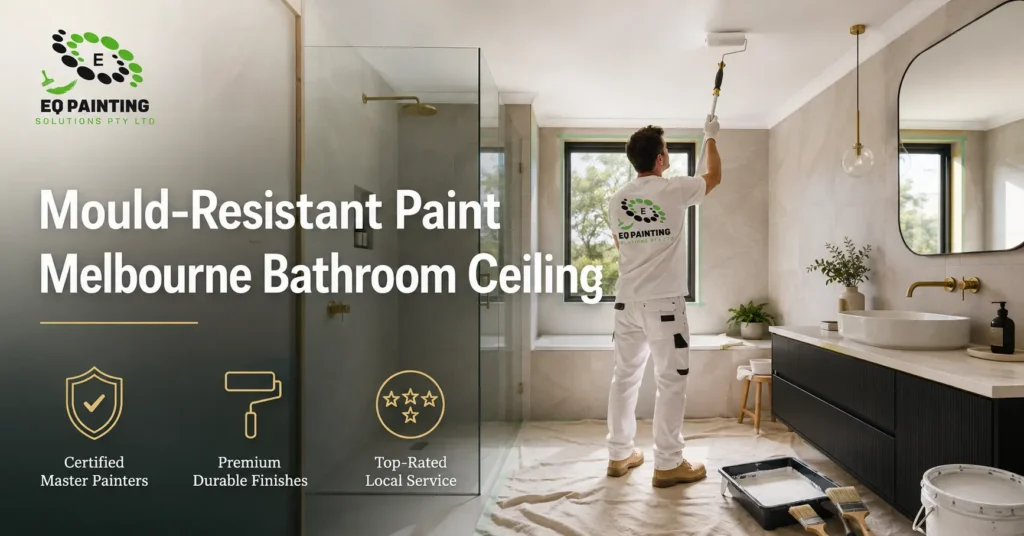
Mould-resistant paint does not kill mould and it will not fix a damp problem. It slows regrowth on a surface that has already been cleaned and dried properly. That distinction matters, because most of the failed jobs we get called to inspect across Melbourne aren’t failures of the paint at all — they’re failures of what happened before the paint went on.
If you’ve got dark speckling creeping across a bathroom ceiling or a shadowy patch on a south-facing bedroom wall, this guide explains what these paints genuinely do, the prep that decides whether they last, and when the job is bigger than a tin of paint. If you’d rather hand it over, our interior painters in Melbourne deal with this most weeks through winter.
What Mould-Resistant Paint Actually Does
Mould-resistant paint contains fungicidal additives in the film that make the painted surface hostile to spore growth. It’s a preventative coating, not a treatment. Painted over live mould, the growth continues underneath and pushes through the film — usually within a few months in a wet Melbourne winter.
Think of it as the last step in a sequence, not the whole solution. The paint protects a clean, dry surface. It cannot dry out a wall, ventilate a room, or stop water getting in.
A label such as mould proof paint should be checked against the exact product’s claim and conditions. Resistance on the dried paint film does not establish that the wall is free from hidden moisture or that existing mould has been treated. Keep moisture assessment and any necessary remediation separate from choosing the finishing paint.
Why Melbourne Homes Get This Problem So Often
Three things stack up here, and most affected homes have at least two of them.
Old housing stock. Across Fitzroy, Brunswick, Richmond and St Kilda, a lot of the Victorian and Edwardian terraces have solid single-brick walls with no cavity and no modern damp course. Those walls sit cold, and cold surfaces collect moisture.
Winter condensation. Melbourne’s July averages hover around 6–14°C. Heat a room, add breathing bodies, showers and drying laundry, and that warm wet air condenses on the coldest surface in the room — typically a south-facing external wall or a ceiling corner. That’s why mould appears in the same spots every winter.
Poor extraction. This is the one homeowners rarely check. Plenty of bathrooms in older Melbourne homes have an exhaust fan that vents straight into the roof cavity instead of outside. The moisture never leaves the building — it just relocates. If your bathroom ceiling keeps going mouldy after repainting, this is the first thing worth checking.
The Different Paints People Confuse
These get used interchangeably in hardware aisles, but they do different jobs.
- Anti-mould / mould-resistant paint — fungicide is built into the film. Products like Zinsser Perma-White are formulated specifically for this and carry a mould-free film warranty.
- Kitchen & bathroom paint — for example Dulux Wash&Wear +PLUS Kitchen & Bathroom. Moisture-tolerant and scrubbable, with some mould inhibition. Good for a normally ventilated bathroom; not a fix for a chronically damp one.
- Anti-condensation paint — contains insulating fillers that keep the surface slightly warmer so moisture is less likely to condense on it. Useful on cold external walls, less relevant on ceilings.
- Standard low-sheen wall paint — no mould defence, absorbs moisture, and in a wet room it will fail. This is what we most often find already on the walls when we’re called out.
Flatter finishes hold moisture longer. In a bathroom or laundry, a low-sheen or semi-gloss will always outlast a matte, regardless of what’s in the tin.
Mould Blocker Paint vs a Stain-Blocking Primer
Mould blocker paint is an imprecise label, so check what the product actually does. A mould-inhibiting topcoat is designed to resist growth on its paint film. A stain-blocking primer is designed to stop a remaining mark showing through the finish; those functions are different, even when a coating system needs both.
Some specialist primers also have mould-treatment claims, which must be checked against their own instructions. Do not assume every stain blocker treats mould, or that a mould-resistant topcoat repairs a moisture problem. Existing growth, leaks and hidden damp need assessment and appropriate treatment before repainting. Extensive, recurring or concealed mould should be assessed by a remediation specialist; the painting scope is agreed separately.
Does Moisture-Proof Paint Fix a Damp Wall?
No ordinary mould-resistant wall paint repairs the cause of a damp wall. The phrase moisture-proof paint can describe very different products: a washable bathroom finish, a mould-inhibiting coating or a specialist moisture-control system. Their claims are not interchangeable.
Recurring damp patches, salt deposits, blistering or hidden mould need the moisture source assessed before repainting. Adding an unapproved barrier over damp masonry can trap or redirect moisture. A bathroom topcoat is also not a substitute for a suitable wet-area waterproofing system. Arrange the appropriate building, plumbing, waterproofing or remediation assessment where needed; EQ’s confirmed role is painting and agreed surface preparation, not a standalone damp-proofing service.
The Right Order to Tackle It
Skip a step here and the paint fails. This is the sequence that works.
- Find and fix the moisture source. Blocked gutter, failed shower seal, leaking flashing, or a fan venting into the roof. Until this is resolved, everything after it is temporary.
- Remove the mould completely. Not painted over, not wiped with bleach — bleach lightens the stain and leaves the roots in porous plaster. Use a proper fungicidal wash and let it dwell.
- Let it dry fully. Days, not hours, on plaster that’s been holding moisture. Painting a damp substrate traps water behind the film.
- Prime with a stain-blocking sealer. A shellac-based or purpose-made stain blocker stops old mould shadowing back through the topcoat.
- Two coats of mould-resistant topcoat. One coat leaves an uneven film thickness, and the thin spots are exactly where regrowth starts.
Not sure which parts of this you’re dealing with? It’s worth getting eyes on it before you buy paint — here’s how to get an accurate painting quote in Melbourne so you’re comparing like for like.
When It’s a Painting Job and When It Isn’t
We’re painters, and we’re straight with people about where that line sits.
A painting job: surface mould on a bathroom ceiling or window reveal from condensation, contained to one area, with no water damage behind it. We clean, prep, prime and coat it properly, and it holds.
Not a painting job: mould spreading across multiple rooms, soft or bulging plaster, a musty smell with no visible source, or anyone in the house with breathing symptoms. That needs a mould remediation specialist first — it’s a different trade with different equipment. Once they’ve cleared it and the structure is dry, we come in and paint it so it doesn’t come back.
Anyone who tells you they’ll just paint over a serious mould problem is selling you a repaint in eighteen months.
Keeping It Away After the Job
The paint buys you protection; habits keep it. Run the exhaust fan for fifteen minutes after every shower, not just during it. Leave the bathroom door open afterwards. Pull furniture a few centimetres off external walls so air can move behind it. Dry laundry outside where you can — an unvented indoor dryer or a clothes horse in a closed room puts litres of water into the air over a winter.
Done properly, a mould-resistant system in a normally used Melbourne bathroom should hold five to seven years before it needs attention.
Related Articles
If you’re planning interior work, these are worth a read too:
- Interior painting tips for Australian homeowners
- Low-VOC and eco-friendly paints for home interiors
- Choosing an interior painting company near you
- House painters in Melbourne
Serving Melbourne Suburbs
EQ Painting Solutions serves Melbourne and surrounding suburbs, including Brunswick, Richmond, St Kilda, South Melbourne. These are service areas; discuss the surface and scope when requesting a quote.
Frequently Asked Questions
It significantly slows regrowth on a properly prepared surface, but only if the moisture source is fixed. On a damp or poorly ventilated wall, mould will return regardless of the paint.
No. Painting over live mould traps it, and it grows through the film within months. It must be cleaned off and the surface dried first.
No. Bleach lightens the stain but leaves the roots in porous plaster. Use a fungicidal wash and let it dwell before rinsing.
Most modern Australian low-VOC options are, once fully cured. Check the VOC rating on the tin and ventilate the room for 48 hours after painting.
Around five to seven years in a normally used Melbourne bathroom, provided ventilation is adequate. Less in a room with an ongoing damp issue.
Washable paint resists marks and scrubbing. Mould-resistant paint contains fungicide in the film. Some kitchen and bathroom paints do both.
Yes, if there is any existing staining. A stain-blocking sealer stops old mould shadows bleeding through the topcoat.
Two. One coat leaves thin spots in the film, and that is where regrowth starts.
A small, contained bathroom ceiling is a realistic DIY job if you follow the prep sequence. Widespread mould, damaged plaster, or an unknown moisture source needs professional assessment.
EQ addresses surface problems and agreed repairs as preparation before painting. Specialist mould remediation, hidden damp and structural moisture problems need separate assessment; this is not a confirmed standalone mould-removal service. Agree the preparation and any specialist work required before repainting.
For a bathroom, pick a dedicated anti mould bathroom paint that combines a fungicide additive with a washable, low-sheen or semi-gloss finish — plain wall paint with a fungicide added is not the same product. This kind of bathroom paint that is mould resistant works best over an unpainted ceiling exhaust fan area and around shower recesses, where humidity sits longest after each use.
Yes — anti mould paint and mould-resistant paint are the same product category, just different names for it. An anti mould paint for bathroom walls and an anti mould paint ceiling coat both work the same way: a fungicide additive in the film that slows regrowth once the surface is properly cleaned and dried before coating.
Not necessarily. A mould-inhibiting topcoat is intended to resist growth on its paint film, while a stain-blocking primer controls marks showing through the finish. Check the specific product claims and treat the moisture source and existing growth appropriately before repainting; neither label establishes that a coating repairs damp.
No. Mould-resistant paint helps resist growth on its paint film; it does not establish that a wall is waterproof or that a leak or damp problem has been repaired. Check the specific product claim and have persistent moisture assessed before repainting. Specialist waterproofing and damp treatment are separate from the agreed painting scope.
Worth Doing Once, Properly
Mould-resistant paint earns its price when it goes on last, over a surface that’s genuinely clean and dry, in a room where the moisture source has been dealt with. Used that way it’s one of the better-value products in a painter’s kit. Used as a shortcut, it’s an expensive stain-blocker that fails by the next winter. (You’ll also see it sold online as “mold paint” or anti-mold paint — the US spelling of the same product type, and the same rules apply.)
If you’ve got a bathroom ceiling, laundry or bedroom wall that keeps going mouldy in Melbourne, we’re happy to look at it and tell you honestly whether it’s a paint job or something that needs a specialist first. Call 0498 200 654 or request a free quote.
Pingback: Can You Paint Over Mould? What a Melbourne Painter Says
Pingback: Do I Need to Prime Before Painting? Melbourne Guide
Pingback: Wall Preparation for Painting: Melbourne Step-by-Step Guide
Pingback: Why Is Paint Bubbling on My Wall? Causes & Fixes (2026)